
The Hooters
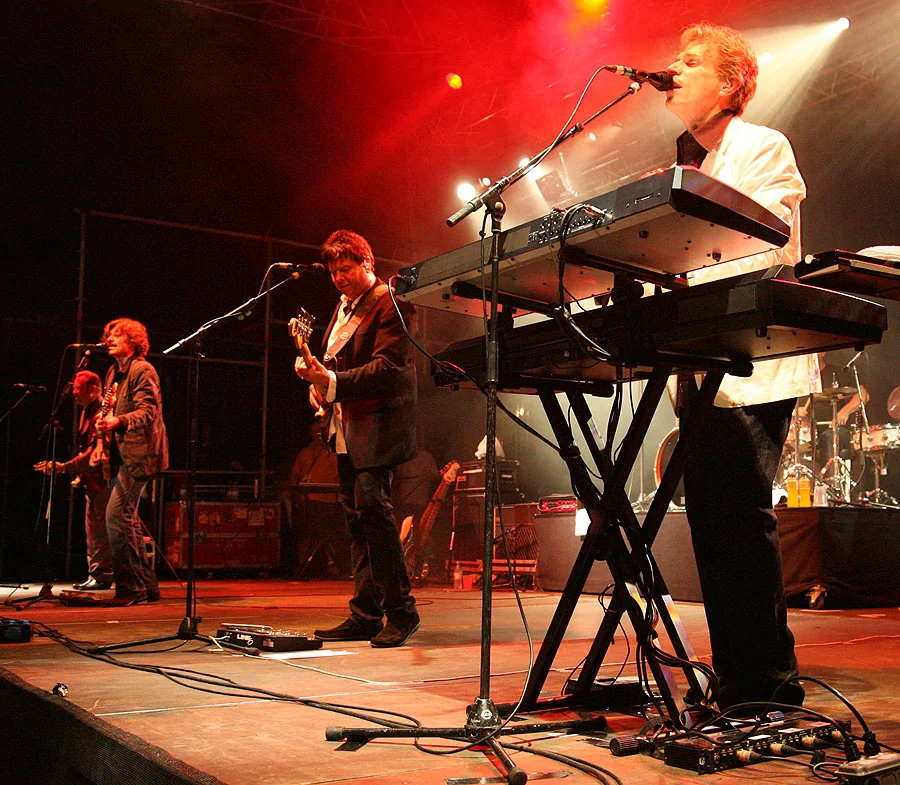
Image from Wikipedia
Image from Wikipedia
The Hooters – The Rock Band from Philadelphia with Heart, Hit-Sensitivity, and Unbroken Live Energy
An American Band Between Folk, Rock, Pop, and Reggae
The Hooters are among those US rock bands that shaped their own style not from a single school, but from a vibrant mix. Founded in 1980 in Philadelphia, the ensemble combined catchy melodies, distinctive guitar work, accordion, keyboards, and an instantly recognizable stage presence into a sound that oscillates between mainstream rock and musical independence. International attention came primarily from their performance at Live Aid in Philadelphia on July 13, 1985, which catapulted the band onto a larger world stage. (de.wikipedia.org)
At the center of the story are Eric Bazilian and Rob Hyman, two creative minds who gained significance not only as musicians but also as songwriters and producers beyond the band. Their career exemplifies how strongly The Hooters rely on collective energy, compositional discipline, and a keen sense for hooklines. It is from this that the unmistakable mix arose that made the band viable in the 1980s and beyond. (de.wikipedia.org)
The Beginnings in Philadelphia: From Local Secret to Independent Rock Voice
The roots of The Hooters lie in the music scene of Philadelphia, which in the early 1980s was a fertile ground for stylistic experiments. Their first single and early releases on an independent basis already brought the group regional attention before their profile sharpened. Munzinger describes the band as a particularly coherent synthesis of folk, pop, rock, and reggae, exactly the style that later became their trademark. (munzinger.de)
The Hooters' early emphasis on live presence profoundly shaped their self-understanding. It was not just the studio, but the interplay on stage, the interaction between instruments and voices, that defined their character. This attitude also explains why the band repeatedly returned to concert halls after years of intensive touring and maintained a solid core of fans there. (hootersmusic.com)
The Breakthrough: Live Aid, Radio Hits, and International Resonance
The big boost came in the mid-1980s. After the band performed at Live Aid in 1985, doors opened that led far beyond the American East Coast. The album Nervous Night became a crucial milestone and achieved gold and platinum status; songs like All You Zombies, Johnny B, and Day by Day were played on the radio, appeared on MTV, and gave the band chart presence. Especially Day by Day climbed significantly in the US charts and underscored that The Hooters were not only a live band but also a precisely hit-oriented songwriting unit. (de.wikipedia.org)
With One Way Home, the group achieved the next strategic step in 1987. The album expanded their sound spectrum, producing further distinctive tracks with Johnny B, Karla With A K, and Satellite, and opened new markets in Europe and Japan. The band's performance on Top of the Pops in the UK illustrates the degree of international recognition that The Hooters achieved during this phase. (hootersmusic.com)
Musical Development: From Acoustic Expansiveness to Southern Grit and German Language
A central characteristic of the band’s history is the constant expansion of their sound. With Zig Zag, The Hooters took a much more acoustic, almost unplugged direction in 1989 and combined this with a more politically aware view of the world. The version of 500 Miles with Peter, Paul and Mary became an international hit and confirmed that the band does not just quote tradition but rearranges it anew. (hootersmusic.com)
In the early 1990s, more colors were added. The band collaborated with multi-instrumentalist Mindy Jostyn, whose violin, harmonica, and mandolin added depth to the sound. The album Out of Body brought new highlights with Twenty-Five Hours a Day and Private Emotion; the latter was later covered by Ricky Martin, impressively demonstrating the lasting potential of the material. Also notable is their openness to the German market: The band released German versions and even wrote songs like Pissing In the Rhine entirely in German. (hootersmusic.com)
This flexibility makes the artistic development of The Hooters so exciting. The band never insisted on a single formula but shifted their balance between rock, folk, pop, and reggae depending on the album. This kept their discography lively and relevant, even as the musical landscape of the 1990s had already changed drastically. (munzinger.de)
Discography and Influential Releases
Among the band's most important releases are Nervous Night and One Way Home, which define the commercial and artistic core of the 1980s. Later came Zig Zag, Out of Body, the live and compilation titles Hooterization, Greatest Hits, and Both Sides Live, as well as the comeback phase with Time Stand Still, Five by Five, Give the Music Back, and Rocking & Swing. These releases showcase a band that not only looks nostalgically back at its past but continuously documents and reformats its repertoire. (hootersmusic.com)
Especially noteworthy is the double strategy of studio work and live releases. Both Sides Live and Give the Music Back document the band from two perspectives: electrifying and acoustic, raw and controlled, spontaneous and arranged. This is a significant part of their authority as both a live act and album band. (hootersmusic.com)
Songwriting, Production, and Cultural Influence
Eric Bazilian and Rob Hyman are among the defining creative forces of the band and have also made an impact far beyond The Hooters. The official band history emphasizes their work on projects with Cyndi Lauper and Joan Osborne; in particular, the songs Time After Time and One of Us symbolize their compositional reach. Other artists have also benefited from this sensibility for melody, structure, and emotional depth. (hootersmusic.com)
Culturally, The Hooters are a band of connections: Philadelphia and Europe, rock and folk, American radio history and German concert culture, studio refinement and festival presence. Their music has resonated particularly strongly in Germany and other European markets, as evidenced by recurring tours and festival appearances. The official band site documents that the group has been working with renewed energy since their reunion in 2001 and continues their decades-long stage presence purposefully. (hootersmusic.com)
Current Projects, Tours, and New Releases
Even decades after their breakthrough, The Hooters remain active. The band announced their first new studio album since 2010, Rocking & Swing, in 2023; the release appeared on their own label Hooters Music and was offered on vinyl, CD, and streaming. In parallel, tour announcements for 2023, 2024, and 2025 were made, including the Europe tour More Rocking, More Swing and the anniversary program 45 Alive. (hootersmusic.com)
The current phase shows a band that does not archive its history but actively lives on. New videos, renewed re-releases of earlier singles, and ongoing concert activities keep the catalog present and make it clear that The Hooters have preserved their identity as a working live band. Their ongoing relevance lies especially in the interplay between repertoire, anniversary tour, and new publications. (hootersmusic.com)
Conclusion: Why The Hooters Continue to Fascinate Today
The Hooters are intriguing because they are more than just a nostalgic act from the '80s. Their music career combines hit potential with craftsmanship, stylistic openness with a clear signature, and American rock energy with European receptiveness. Those who experience this band live do not just get a mere retrospection but a precisely played, heartfelt, and powerful demonstration of how enduring great songs, strong arrangements, and true stage presence can be. (hootersmusic.com)
Official Channels of The Hooters:
- Instagram: No official profile found
- Facebook: No official profile found
- YouTube: No official profile found
- Spotify: No official profile found
- TikTok: No official profile found