
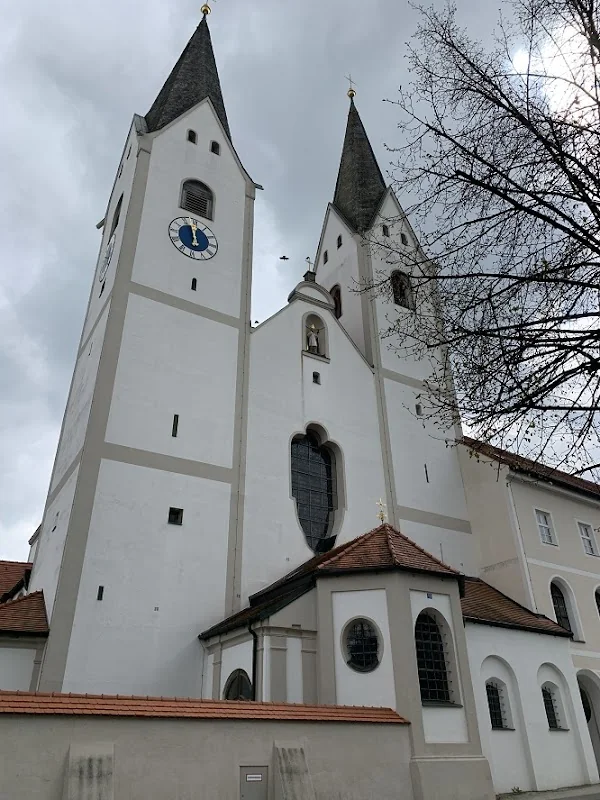
Markt Indersdorf
Marienpl. 1, 85229 Markt Indersdorf, Deutschland
Collegiate Church of the Assumption | History & Rococo
The Collegiate Church of the Assumption in Markt Indersdorf is a place where spiritual tradition, architectural history, and regional identity come together in a small space. It is located in the historical monastery area, is now part of the parish association Indersdorf, and is also a monument with remarkable continuity: from the medieval Augustinian canonry, it has become a vibrant parish church that continues to shape the town center to this day. Those looking for history, photos, visits, services, directions, or parking will find here not only a beautiful church motif but also a building of supra-regional significance and clear presence. The mixture of medieval origins, Baroque forms, Rococo expression, and active community life makes the collegiate church a destination that appeals to both culture enthusiasts and quiet visitors who wish to experience the special character of a historical sacred space. ([markt-indersdorf.de](https://www.markt-indersdorf.de/freizeit-kultur/900-jahre-kloster-indersdorf/geschichte-des-klosters/))
History of the Monastery and the Collegiate Church
The history begins with a foundation born of atonement, reform intent, and dynastic significance: Count Palatine Otto IV of Wittelsbach founded the Augustinian canonry Indersdorf in 1120 at the behest of Pope Calixtus II as a sign of penance for his involvement in the Italian campaign of Emperor Henry V. In 1126, the first canons arrived from Marbach in Alsace, and just two years later, the first church was consecrated in honor of the Mother of God and the apostolic princes Peter and Paul. Thus, Indersdorf very early on became one of the house monasteries of the Wittelsbachs and became a spiritual, economic, and cultural center of the region. The official community site also points out that seven counts palatine of the Wittelsbach family are buried within the current monastery walls, which clearly illustrates the close connection between the founding dynasty and the monastery. Therefore, anyone visiting the church today stands in a place that has always been more than just a religious building: it was an expression of power, memory, piety, and territorial identity. ([markt-indersdorf.de](https://www.markt-indersdorf.de/freizeit-kultur/900-jahre-kloster-indersdorf/geschichte-des-klosters/))
After the great fire of 1249, the complex was rebuilt, and during this phase, several architectural styles and layers of use began to converge, which contribute to the charm of the current building. Beneath the present Rococo facade, the foundations of a Romanesque basilica without a transept with three apses still lie hidden, which initially possessed a clear, austere form. Later, Gothic ribbed vaults, the construction of the Rosary Chapel, and the south tower followed, so that the space increasingly gained height, movement, and liturgical depth. The Thirty Years' War brought plundering and significant losses before the Baroque and finally Rococo transformations began in the 17th and 18th centuries. The canonry lost its monastic function in 1783, and in 1803, the monastery and church were secularized, but the church was preserved and continues to serve as a parish church to this day. This transition from monastic past to lived present makes the collegiate church in Markt Indersdorf so interesting: it is a monument that has not become stagnant but has continually adapted over many centuries. ([markt-indersdorf.de](https://www.markt-indersdorf.de/freizeit-kultur/900-jahre-kloster-indersdorf/geschichte-des-klosters/))
Rococo Furnishings, Frescoes, and Baroque Art in the Church Space
Much of the interior design focuses on the major transformation phase of the 18th century. The community history describes that Provost Gelasius Morhart commissioned the redesign of the church and monastery in the Rococo style and engaged the Augsburg fresco artist Matthäus Günther, his student Johann Georg Dieffenbrunner, and the Wessobrunn stucco artist Franz Xaver Feichtmeier the Elder. These names represent an artistic ambition that goes far beyond mere craftsmanship. The church space thus became a place where light, color, stucco, and painting consciously interact. For inquiries about photos or the special interior, it is important to note: The collegiate church thrives on the contrast between its medieval core and Baroque brilliance. This contrast is no coincidence but an expression of a long development in which the old monastery continually re-staged itself and adapted the sacred space to the aesthetics of its time. Therefore, upon entering the space, one experiences not just a church but a layering of art and piety history that is among the more impressive examples in Bavaria. ([markt-indersdorf.de](https://www.markt-indersdorf.de/freizeit-kultur/900-jahre-kloster-indersdorf/geschichte-des-klosters/))
The recent renovation of 2021 shows how carefully this heritage is maintained today. The State Building Authority of Freising restored the roof, renovated the bell tower, gave the church a new white-gray paint job, and restored several Rococo frescoes and figures, especially in the area above the organ loft and on the ceilings of the side aisles. The organ was also cleaned, the loft structurally reinforced, and the Baroque sacristy furnishings finally restored. These works are not only technically important but also shape the impression of the entire interior: it now appears clear, well-kept, and its art-historical impact is easily readable. For visitors, this means that the collegiate church does not come across as an overloaded museum but as a vibrant space where restoration and use are harmonized. This makes the place equally attractive for photos, architectural studies, and quiet visits. ([stbafs.bayern.de](https://stbafs.bayern.de/hochbau/projekte/B11H.E0552400.01.html))
Services, Parish Association, and Visits
Today, the Assumption of Mary is not just a museum site but a lively parish church in the parish association Indersdorf. The parish association includes not only Indersdorf but also St. Michael Langenpettenbach, St. Georg Niederroth, and St. Korbinian Westerholzhausen; the website describes the collaborative work as a network of services, religious education, festivals, and everyday support. The parish office is also clearly located there: Marienplatz 4 in Markt Indersdorf, with office hours-related consultation times as well as phone and email contact. For those looking for services at the Assumption of Mary, the parish association Indersdorf, or current dates, this is important because the collegiate church is part of an active pastoral routine and not just a historical site. Therefore, anyone planning a visit should check the current notices from the parish association, especially if a service, wedding, devotion, or community event is taking place. ([pfarrverband-indersdorf.de](https://www.pfarrverband-indersdorf.de/))
The monument notice is also helpful for visit planning. The entry for the Open Monument Day explicitly states that tours and visits for the former monastery church are only offered as part of the scheduled program points. This shows that access varies depending on the occasion and does not automatically occur as with an open-air monument. However, therein lies a charm: the church is not arbitrarily consumable but is experienced within a framework that respects its liturgical and historical dignity. For visitors, this means that checking current dates is worthwhile before setting out. Those visiting the site in connection with a service experience the interplay of history, music, architecture, and community particularly directly. Those coming on a program day gain additional professional context and often a significant added value compared to merely passing by. ([tag-des-offenen-denkmals.de](https://www.tag-des-offenen-denkmals.de/denkmal/0905628e-dff6-11ec-956a-960000a15311/ehemalige-klosterkirche-maria-himmelfahrt?utm_source=openai))
Directions, Marienplatz, and Parking in Kloster Indersdorf
The location at the historic Marienplatz is one of the greatest advantages of the collegiate church. It is situated in the middle of the monastery ensemble of Markt Indersdorf and is therefore very well suited as part of a walk through the town center. The monument and event environment shows that this area has been understood as a cultural focus of the market for years: the anniversary project celebrating 900 years of Kloster Indersdorf explicitly locates the complex as one of the most significant monastery complexes in Old Bavaria, and the place itself utilizes the historical context for events, exhibitions, and community work. Thus, when visiting the church, one is not moving to an isolated individual building but within a closely intertwined monument and townscape. This makes the journey easy to plan for first-time visitors because the entire area is clearly readable as a historical central core. ([markt-indersdorf.de](https://www.markt-indersdorf.de/freizeit-kultur/900-jahre-kloster-indersdorf/?utm_source=openai))
Regarding parking, the available sources at least provide one reliable practical tip: the monument entry lists a parking space. For events in the monastery area, the community additionally mentions areas such as the Rothbachwiese right by the Klosterbräu beer garden and the folk festival grounds east of the Glonn bridge. For those traveling by train, the community site refers to the S2 from Munich towards Altomünster. This is especially useful if one wishes to visit the church in combination with a walk through the town or if increased traffic is expected on days with services and events. It remains important that the actual availability of parking spaces may vary depending on the occasion. Therefore, anyone with an appointment should check the current notices from the parish association and the community and plan some buffer time. This way, the visit can be comfortably connected with the historical town center. ([tag-des-offenen-denkmals.de](https://www.tag-des-offenen-denkmals.de/denkmal/0905628e-dff6-11ec-956a-960000a15311/ehemalige-klosterkirche-maria-himmelfahrt?utm_source=openai))
Photos, Architecture, and Monument Character
The collegiate church is architecturally fascinating because it visibly overlays several epochs instead of showing just a single style phase. Romanesque foundations, Gothic vaults, Baroque construction measures, and the Rococo furnishings of the 18th century together create a space that feels calm yet very rich. This contrast makes the church interesting for photographers, cultural travelers, and architecture enthusiasts: outside as part of the historical monastery complex, inside as a bright, artistically staged church space with clear spatial effects. Those searching for photos are not only looking for a beautiful motif but also for a monument that works with light, surface, and proportion. The special charm lies in the fact that the building has not been smoothly modernized but has retained its history visibly. This makes the collegiate church a place where one can almost read the development from the Romanesque church through the Gothic formation to the Baroque and Rococo refinement like in a textbook. ([markt-indersdorf.de](https://www.markt-indersdorf.de/freizeit-kultur/900-jahre-kloster-indersdorf/geschichte-des-klosters/))
The documented restoration works also help to better understand the monument character. The State Building Authority of Freising photographs the condition and restoration, and such documentation shows how sensitively historical surfaces, frescoes, figures, and the church space are treated. For visitors, this means that the best impression is not created by merely passing by quickly but by consciously perceiving the transitions. How does the light fall on the bright interior? How do the Baroque and Rococo elements relate to the older masonry? How does the impression shift when one views the church not only from the outside but as part of the entire monastery ensemble? Such questions transform a simple photo motif into a true cultural site. The collegiate church is therefore not only beautiful but also legible, and this legibility is the reason why many people remember it so well. ([stbafs.bayern.de](https://stbafs.bayern.de/hochbau/projekte/B11H.E0552400.01.html))
Monastery Ensemble and Significance for Markt Indersdorf
Kloster Indersdorf is one of the most significant monastery complexes in Old Bavaria and has shaped the town for many centuries. The community site for the 900th anniversary of Kloster Indersdorf describes in detail that the canonry was not only a spiritual center but also had economic, cultural, and even scientific significance in the 18th century. This historical depth explains why the Collegiate Church of the Assumption is much more for Markt Indersdorf than just a beautiful individual monument. It is part of a larger narrative about reform, education, rule, piety, and regional development. Those visiting the site quickly recognize that the church, monastery courtyard, and town center belong together and continue to shape the character of the market visibly to this day. This is precisely why such buildings are so important for the self-understanding of a community: they provide not only a past but also an identity. ([markt-indersdorf.de](https://www.markt-indersdorf.de/freizeit-kultur/900-jahre-kloster-indersdorf/?utm_source=openai))
For today's perception, it is also important that the parish association Indersdorf does not treat the church as an isolated monument but as part of a lively religious and social network. Community, charity, festivals, educational offerings, and regular services give the place a presence that goes beyond mere monument preservation. This explains the frequent inquiries about terms like history, photos, services, visits, directions, and parking: people want to know not only how old the church is but also how it functions, when it is accessible, and how to visit it meaningfully. The Collegiate Church of the Assumption answers all these questions in a special way because it connects historical depth with current use. Therefore, those making their way to Markt Indersdorf do not experience a static monument but a place where past, art, and community life come together. ([pfarrverband-indersdorf.de](https://www.pfarrverband-indersdorf.de/))
Sources:
- Markt Indersdorf - History of the Monastery
- Parish Association Indersdorf - Homepage
- State Building Authority Freising - Restoration of the Monastery Church of the Assumption
- Open Monument Day - Former Monastery Church of the Assumption
- Markt Indersdorf - Advent at the Monastery Directions
- Markt Indersdorf - 900 Years of Kloster Indersdorf
Show moreShow less
Collegiate Church of the Assumption | History & Rococo
The Collegiate Church of the Assumption in Markt Indersdorf is a place where spiritual tradition, architectural history, and regional identity come together in a small space. It is located in the historical monastery area, is now part of the parish association Indersdorf, and is also a monument with remarkable continuity: from the medieval Augustinian canonry, it has become a vibrant parish church that continues to shape the town center to this day. Those looking for history, photos, visits, services, directions, or parking will find here not only a beautiful church motif but also a building of supra-regional significance and clear presence. The mixture of medieval origins, Baroque forms, Rococo expression, and active community life makes the collegiate church a destination that appeals to both culture enthusiasts and quiet visitors who wish to experience the special character of a historical sacred space. ([markt-indersdorf.de](https://www.markt-indersdorf.de/freizeit-kultur/900-jahre-kloster-indersdorf/geschichte-des-klosters/))
History of the Monastery and the Collegiate Church
The history begins with a foundation born of atonement, reform intent, and dynastic significance: Count Palatine Otto IV of Wittelsbach founded the Augustinian canonry Indersdorf in 1120 at the behest of Pope Calixtus II as a sign of penance for his involvement in the Italian campaign of Emperor Henry V. In 1126, the first canons arrived from Marbach in Alsace, and just two years later, the first church was consecrated in honor of the Mother of God and the apostolic princes Peter and Paul. Thus, Indersdorf very early on became one of the house monasteries of the Wittelsbachs and became a spiritual, economic, and cultural center of the region. The official community site also points out that seven counts palatine of the Wittelsbach family are buried within the current monastery walls, which clearly illustrates the close connection between the founding dynasty and the monastery. Therefore, anyone visiting the church today stands in a place that has always been more than just a religious building: it was an expression of power, memory, piety, and territorial identity. ([markt-indersdorf.de](https://www.markt-indersdorf.de/freizeit-kultur/900-jahre-kloster-indersdorf/geschichte-des-klosters/))
After the great fire of 1249, the complex was rebuilt, and during this phase, several architectural styles and layers of use began to converge, which contribute to the charm of the current building. Beneath the present Rococo facade, the foundations of a Romanesque basilica without a transept with three apses still lie hidden, which initially possessed a clear, austere form. Later, Gothic ribbed vaults, the construction of the Rosary Chapel, and the south tower followed, so that the space increasingly gained height, movement, and liturgical depth. The Thirty Years' War brought plundering and significant losses before the Baroque and finally Rococo transformations began in the 17th and 18th centuries. The canonry lost its monastic function in 1783, and in 1803, the monastery and church were secularized, but the church was preserved and continues to serve as a parish church to this day. This transition from monastic past to lived present makes the collegiate church in Markt Indersdorf so interesting: it is a monument that has not become stagnant but has continually adapted over many centuries. ([markt-indersdorf.de](https://www.markt-indersdorf.de/freizeit-kultur/900-jahre-kloster-indersdorf/geschichte-des-klosters/))
Rococo Furnishings, Frescoes, and Baroque Art in the Church Space
Much of the interior design focuses on the major transformation phase of the 18th century. The community history describes that Provost Gelasius Morhart commissioned the redesign of the church and monastery in the Rococo style and engaged the Augsburg fresco artist Matthäus Günther, his student Johann Georg Dieffenbrunner, and the Wessobrunn stucco artist Franz Xaver Feichtmeier the Elder. These names represent an artistic ambition that goes far beyond mere craftsmanship. The church space thus became a place where light, color, stucco, and painting consciously interact. For inquiries about photos or the special interior, it is important to note: The collegiate church thrives on the contrast between its medieval core and Baroque brilliance. This contrast is no coincidence but an expression of a long development in which the old monastery continually re-staged itself and adapted the sacred space to the aesthetics of its time. Therefore, upon entering the space, one experiences not just a church but a layering of art and piety history that is among the more impressive examples in Bavaria. ([markt-indersdorf.de](https://www.markt-indersdorf.de/freizeit-kultur/900-jahre-kloster-indersdorf/geschichte-des-klosters/))
The recent renovation of 2021 shows how carefully this heritage is maintained today. The State Building Authority of Freising restored the roof, renovated the bell tower, gave the church a new white-gray paint job, and restored several Rococo frescoes and figures, especially in the area above the organ loft and on the ceilings of the side aisles. The organ was also cleaned, the loft structurally reinforced, and the Baroque sacristy furnishings finally restored. These works are not only technically important but also shape the impression of the entire interior: it now appears clear, well-kept, and its art-historical impact is easily readable. For visitors, this means that the collegiate church does not come across as an overloaded museum but as a vibrant space where restoration and use are harmonized. This makes the place equally attractive for photos, architectural studies, and quiet visits. ([stbafs.bayern.de](https://stbafs.bayern.de/hochbau/projekte/B11H.E0552400.01.html))
Services, Parish Association, and Visits
Today, the Assumption of Mary is not just a museum site but a lively parish church in the parish association Indersdorf. The parish association includes not only Indersdorf but also St. Michael Langenpettenbach, St. Georg Niederroth, and St. Korbinian Westerholzhausen; the website describes the collaborative work as a network of services, religious education, festivals, and everyday support. The parish office is also clearly located there: Marienplatz 4 in Markt Indersdorf, with office hours-related consultation times as well as phone and email contact. For those looking for services at the Assumption of Mary, the parish association Indersdorf, or current dates, this is important because the collegiate church is part of an active pastoral routine and not just a historical site. Therefore, anyone planning a visit should check the current notices from the parish association, especially if a service, wedding, devotion, or community event is taking place. ([pfarrverband-indersdorf.de](https://www.pfarrverband-indersdorf.de/))
The monument notice is also helpful for visit planning. The entry for the Open Monument Day explicitly states that tours and visits for the former monastery church are only offered as part of the scheduled program points. This shows that access varies depending on the occasion and does not automatically occur as with an open-air monument. However, therein lies a charm: the church is not arbitrarily consumable but is experienced within a framework that respects its liturgical and historical dignity. For visitors, this means that checking current dates is worthwhile before setting out. Those visiting the site in connection with a service experience the interplay of history, music, architecture, and community particularly directly. Those coming on a program day gain additional professional context and often a significant added value compared to merely passing by. ([tag-des-offenen-denkmals.de](https://www.tag-des-offenen-denkmals.de/denkmal/0905628e-dff6-11ec-956a-960000a15311/ehemalige-klosterkirche-maria-himmelfahrt?utm_source=openai))
Directions, Marienplatz, and Parking in Kloster Indersdorf
The location at the historic Marienplatz is one of the greatest advantages of the collegiate church. It is situated in the middle of the monastery ensemble of Markt Indersdorf and is therefore very well suited as part of a walk through the town center. The monument and event environment shows that this area has been understood as a cultural focus of the market for years: the anniversary project celebrating 900 years of Kloster Indersdorf explicitly locates the complex as one of the most significant monastery complexes in Old Bavaria, and the place itself utilizes the historical context for events, exhibitions, and community work. Thus, when visiting the church, one is not moving to an isolated individual building but within a closely intertwined monument and townscape. This makes the journey easy to plan for first-time visitors because the entire area is clearly readable as a historical central core. ([markt-indersdorf.de](https://www.markt-indersdorf.de/freizeit-kultur/900-jahre-kloster-indersdorf/?utm_source=openai))
Regarding parking, the available sources at least provide one reliable practical tip: the monument entry lists a parking space. For events in the monastery area, the community additionally mentions areas such as the Rothbachwiese right by the Klosterbräu beer garden and the folk festival grounds east of the Glonn bridge. For those traveling by train, the community site refers to the S2 from Munich towards Altomünster. This is especially useful if one wishes to visit the church in combination with a walk through the town or if increased traffic is expected on days with services and events. It remains important that the actual availability of parking spaces may vary depending on the occasion. Therefore, anyone with an appointment should check the current notices from the parish association and the community and plan some buffer time. This way, the visit can be comfortably connected with the historical town center. ([tag-des-offenen-denkmals.de](https://www.tag-des-offenen-denkmals.de/denkmal/0905628e-dff6-11ec-956a-960000a15311/ehemalige-klosterkirche-maria-himmelfahrt?utm_source=openai))
Photos, Architecture, and Monument Character
The collegiate church is architecturally fascinating because it visibly overlays several epochs instead of showing just a single style phase. Romanesque foundations, Gothic vaults, Baroque construction measures, and the Rococo furnishings of the 18th century together create a space that feels calm yet very rich. This contrast makes the church interesting for photographers, cultural travelers, and architecture enthusiasts: outside as part of the historical monastery complex, inside as a bright, artistically staged church space with clear spatial effects. Those searching for photos are not only looking for a beautiful motif but also for a monument that works with light, surface, and proportion. The special charm lies in the fact that the building has not been smoothly modernized but has retained its history visibly. This makes the collegiate church a place where one can almost read the development from the Romanesque church through the Gothic formation to the Baroque and Rococo refinement like in a textbook. ([markt-indersdorf.de](https://www.markt-indersdorf.de/freizeit-kultur/900-jahre-kloster-indersdorf/geschichte-des-klosters/))
The documented restoration works also help to better understand the monument character. The State Building Authority of Freising photographs the condition and restoration, and such documentation shows how sensitively historical surfaces, frescoes, figures, and the church space are treated. For visitors, this means that the best impression is not created by merely passing by quickly but by consciously perceiving the transitions. How does the light fall on the bright interior? How do the Baroque and Rococo elements relate to the older masonry? How does the impression shift when one views the church not only from the outside but as part of the entire monastery ensemble? Such questions transform a simple photo motif into a true cultural site. The collegiate church is therefore not only beautiful but also legible, and this legibility is the reason why many people remember it so well. ([stbafs.bayern.de](https://stbafs.bayern.de/hochbau/projekte/B11H.E0552400.01.html))
Monastery Ensemble and Significance for Markt Indersdorf
Kloster Indersdorf is one of the most significant monastery complexes in Old Bavaria and has shaped the town for many centuries. The community site for the 900th anniversary of Kloster Indersdorf describes in detail that the canonry was not only a spiritual center but also had economic, cultural, and even scientific significance in the 18th century. This historical depth explains why the Collegiate Church of the Assumption is much more for Markt Indersdorf than just a beautiful individual monument. It is part of a larger narrative about reform, education, rule, piety, and regional development. Those visiting the site quickly recognize that the church, monastery courtyard, and town center belong together and continue to shape the character of the market visibly to this day. This is precisely why such buildings are so important for the self-understanding of a community: they provide not only a past but also an identity. ([markt-indersdorf.de](https://www.markt-indersdorf.de/freizeit-kultur/900-jahre-kloster-indersdorf/?utm_source=openai))
For today's perception, it is also important that the parish association Indersdorf does not treat the church as an isolated monument but as part of a lively religious and social network. Community, charity, festivals, educational offerings, and regular services give the place a presence that goes beyond mere monument preservation. This explains the frequent inquiries about terms like history, photos, services, visits, directions, and parking: people want to know not only how old the church is but also how it functions, when it is accessible, and how to visit it meaningfully. The Collegiate Church of the Assumption answers all these questions in a special way because it connects historical depth with current use. Therefore, those making their way to Markt Indersdorf do not experience a static monument but a place where past, art, and community life come together. ([pfarrverband-indersdorf.de](https://www.pfarrverband-indersdorf.de/))
Sources:
- Markt Indersdorf - History of the Monastery
- Parish Association Indersdorf - Homepage
- State Building Authority Freising - Restoration of the Monastery Church of the Assumption
- Open Monument Day - Former Monastery Church of the Assumption
- Markt Indersdorf - Advent at the Monastery Directions
- Markt Indersdorf - 900 Years of Kloster Indersdorf
Collegiate Church of the Assumption | History & Rococo
The Collegiate Church of the Assumption in Markt Indersdorf is a place where spiritual tradition, architectural history, and regional identity come together in a small space. It is located in the historical monastery area, is now part of the parish association Indersdorf, and is also a monument with remarkable continuity: from the medieval Augustinian canonry, it has become a vibrant parish church that continues to shape the town center to this day. Those looking for history, photos, visits, services, directions, or parking will find here not only a beautiful church motif but also a building of supra-regional significance and clear presence. The mixture of medieval origins, Baroque forms, Rococo expression, and active community life makes the collegiate church a destination that appeals to both culture enthusiasts and quiet visitors who wish to experience the special character of a historical sacred space. ([markt-indersdorf.de](https://www.markt-indersdorf.de/freizeit-kultur/900-jahre-kloster-indersdorf/geschichte-des-klosters/))
History of the Monastery and the Collegiate Church
The history begins with a foundation born of atonement, reform intent, and dynastic significance: Count Palatine Otto IV of Wittelsbach founded the Augustinian canonry Indersdorf in 1120 at the behest of Pope Calixtus II as a sign of penance for his involvement in the Italian campaign of Emperor Henry V. In 1126, the first canons arrived from Marbach in Alsace, and just two years later, the first church was consecrated in honor of the Mother of God and the apostolic princes Peter and Paul. Thus, Indersdorf very early on became one of the house monasteries of the Wittelsbachs and became a spiritual, economic, and cultural center of the region. The official community site also points out that seven counts palatine of the Wittelsbach family are buried within the current monastery walls, which clearly illustrates the close connection between the founding dynasty and the monastery. Therefore, anyone visiting the church today stands in a place that has always been more than just a religious building: it was an expression of power, memory, piety, and territorial identity. ([markt-indersdorf.de](https://www.markt-indersdorf.de/freizeit-kultur/900-jahre-kloster-indersdorf/geschichte-des-klosters/))
After the great fire of 1249, the complex was rebuilt, and during this phase, several architectural styles and layers of use began to converge, which contribute to the charm of the current building. Beneath the present Rococo facade, the foundations of a Romanesque basilica without a transept with three apses still lie hidden, which initially possessed a clear, austere form. Later, Gothic ribbed vaults, the construction of the Rosary Chapel, and the south tower followed, so that the space increasingly gained height, movement, and liturgical depth. The Thirty Years' War brought plundering and significant losses before the Baroque and finally Rococo transformations began in the 17th and 18th centuries. The canonry lost its monastic function in 1783, and in 1803, the monastery and church were secularized, but the church was preserved and continues to serve as a parish church to this day. This transition from monastic past to lived present makes the collegiate church in Markt Indersdorf so interesting: it is a monument that has not become stagnant but has continually adapted over many centuries. ([markt-indersdorf.de](https://www.markt-indersdorf.de/freizeit-kultur/900-jahre-kloster-indersdorf/geschichte-des-klosters/))
Rococo Furnishings, Frescoes, and Baroque Art in the Church Space
Much of the interior design focuses on the major transformation phase of the 18th century. The community history describes that Provost Gelasius Morhart commissioned the redesign of the church and monastery in the Rococo style and engaged the Augsburg fresco artist Matthäus Günther, his student Johann Georg Dieffenbrunner, and the Wessobrunn stucco artist Franz Xaver Feichtmeier the Elder. These names represent an artistic ambition that goes far beyond mere craftsmanship. The church space thus became a place where light, color, stucco, and painting consciously interact. For inquiries about photos or the special interior, it is important to note: The collegiate church thrives on the contrast between its medieval core and Baroque brilliance. This contrast is no coincidence but an expression of a long development in which the old monastery continually re-staged itself and adapted the sacred space to the aesthetics of its time. Therefore, upon entering the space, one experiences not just a church but a layering of art and piety history that is among the more impressive examples in Bavaria. ([markt-indersdorf.de](https://www.markt-indersdorf.de/freizeit-kultur/900-jahre-kloster-indersdorf/geschichte-des-klosters/))
The recent renovation of 2021 shows how carefully this heritage is maintained today. The State Building Authority of Freising restored the roof, renovated the bell tower, gave the church a new white-gray paint job, and restored several Rococo frescoes and figures, especially in the area above the organ loft and on the ceilings of the side aisles. The organ was also cleaned, the loft structurally reinforced, and the Baroque sacristy furnishings finally restored. These works are not only technically important but also shape the impression of the entire interior: it now appears clear, well-kept, and its art-historical impact is easily readable. For visitors, this means that the collegiate church does not come across as an overloaded museum but as a vibrant space where restoration and use are harmonized. This makes the place equally attractive for photos, architectural studies, and quiet visits. ([stbafs.bayern.de](https://stbafs.bayern.de/hochbau/projekte/B11H.E0552400.01.html))
Services, Parish Association, and Visits
Today, the Assumption of Mary is not just a museum site but a lively parish church in the parish association Indersdorf. The parish association includes not only Indersdorf but also St. Michael Langenpettenbach, St. Georg Niederroth, and St. Korbinian Westerholzhausen; the website describes the collaborative work as a network of services, religious education, festivals, and everyday support. The parish office is also clearly located there: Marienplatz 4 in Markt Indersdorf, with office hours-related consultation times as well as phone and email contact. For those looking for services at the Assumption of Mary, the parish association Indersdorf, or current dates, this is important because the collegiate church is part of an active pastoral routine and not just a historical site. Therefore, anyone planning a visit should check the current notices from the parish association, especially if a service, wedding, devotion, or community event is taking place. ([pfarrverband-indersdorf.de](https://www.pfarrverband-indersdorf.de/))
The monument notice is also helpful for visit planning. The entry for the Open Monument Day explicitly states that tours and visits for the former monastery church are only offered as part of the scheduled program points. This shows that access varies depending on the occasion and does not automatically occur as with an open-air monument. However, therein lies a charm: the church is not arbitrarily consumable but is experienced within a framework that respects its liturgical and historical dignity. For visitors, this means that checking current dates is worthwhile before setting out. Those visiting the site in connection with a service experience the interplay of history, music, architecture, and community particularly directly. Those coming on a program day gain additional professional context and often a significant added value compared to merely passing by. ([tag-des-offenen-denkmals.de](https://www.tag-des-offenen-denkmals.de/denkmal/0905628e-dff6-11ec-956a-960000a15311/ehemalige-klosterkirche-maria-himmelfahrt?utm_source=openai))
Directions, Marienplatz, and Parking in Kloster Indersdorf
The location at the historic Marienplatz is one of the greatest advantages of the collegiate church. It is situated in the middle of the monastery ensemble of Markt Indersdorf and is therefore very well suited as part of a walk through the town center. The monument and event environment shows that this area has been understood as a cultural focus of the market for years: the anniversary project celebrating 900 years of Kloster Indersdorf explicitly locates the complex as one of the most significant monastery complexes in Old Bavaria, and the place itself utilizes the historical context for events, exhibitions, and community work. Thus, when visiting the church, one is not moving to an isolated individual building but within a closely intertwined monument and townscape. This makes the journey easy to plan for first-time visitors because the entire area is clearly readable as a historical central core. ([markt-indersdorf.de](https://www.markt-indersdorf.de/freizeit-kultur/900-jahre-kloster-indersdorf/?utm_source=openai))
Regarding parking, the available sources at least provide one reliable practical tip: the monument entry lists a parking space. For events in the monastery area, the community additionally mentions areas such as the Rothbachwiese right by the Klosterbräu beer garden and the folk festival grounds east of the Glonn bridge. For those traveling by train, the community site refers to the S2 from Munich towards Altomünster. This is especially useful if one wishes to visit the church in combination with a walk through the town or if increased traffic is expected on days with services and events. It remains important that the actual availability of parking spaces may vary depending on the occasion. Therefore, anyone with an appointment should check the current notices from the parish association and the community and plan some buffer time. This way, the visit can be comfortably connected with the historical town center. ([tag-des-offenen-denkmals.de](https://www.tag-des-offenen-denkmals.de/denkmal/0905628e-dff6-11ec-956a-960000a15311/ehemalige-klosterkirche-maria-himmelfahrt?utm_source=openai))
Photos, Architecture, and Monument Character
The collegiate church is architecturally fascinating because it visibly overlays several epochs instead of showing just a single style phase. Romanesque foundations, Gothic vaults, Baroque construction measures, and the Rococo furnishings of the 18th century together create a space that feels calm yet very rich. This contrast makes the church interesting for photographers, cultural travelers, and architecture enthusiasts: outside as part of the historical monastery complex, inside as a bright, artistically staged church space with clear spatial effects. Those searching for photos are not only looking for a beautiful motif but also for a monument that works with light, surface, and proportion. The special charm lies in the fact that the building has not been smoothly modernized but has retained its history visibly. This makes the collegiate church a place where one can almost read the development from the Romanesque church through the Gothic formation to the Baroque and Rococo refinement like in a textbook. ([markt-indersdorf.de](https://www.markt-indersdorf.de/freizeit-kultur/900-jahre-kloster-indersdorf/geschichte-des-klosters/))
The documented restoration works also help to better understand the monument character. The State Building Authority of Freising photographs the condition and restoration, and such documentation shows how sensitively historical surfaces, frescoes, figures, and the church space are treated. For visitors, this means that the best impression is not created by merely passing by quickly but by consciously perceiving the transitions. How does the light fall on the bright interior? How do the Baroque and Rococo elements relate to the older masonry? How does the impression shift when one views the church not only from the outside but as part of the entire monastery ensemble? Such questions transform a simple photo motif into a true cultural site. The collegiate church is therefore not only beautiful but also legible, and this legibility is the reason why many people remember it so well. ([stbafs.bayern.de](https://stbafs.bayern.de/hochbau/projekte/B11H.E0552400.01.html))
Monastery Ensemble and Significance for Markt Indersdorf
Kloster Indersdorf is one of the most significant monastery complexes in Old Bavaria and has shaped the town for many centuries. The community site for the 900th anniversary of Kloster Indersdorf describes in detail that the canonry was not only a spiritual center but also had economic, cultural, and even scientific significance in the 18th century. This historical depth explains why the Collegiate Church of the Assumption is much more for Markt Indersdorf than just a beautiful individual monument. It is part of a larger narrative about reform, education, rule, piety, and regional development. Those visiting the site quickly recognize that the church, monastery courtyard, and town center belong together and continue to shape the character of the market visibly to this day. This is precisely why such buildings are so important for the self-understanding of a community: they provide not only a past but also an identity. ([markt-indersdorf.de](https://www.markt-indersdorf.de/freizeit-kultur/900-jahre-kloster-indersdorf/?utm_source=openai))
For today's perception, it is also important that the parish association Indersdorf does not treat the church as an isolated monument but as part of a lively religious and social network. Community, charity, festivals, educational offerings, and regular services give the place a presence that goes beyond mere monument preservation. This explains the frequent inquiries about terms like history, photos, services, visits, directions, and parking: people want to know not only how old the church is but also how it functions, when it is accessible, and how to visit it meaningfully. The Collegiate Church of the Assumption answers all these questions in a special way because it connects historical depth with current use. Therefore, those making their way to Markt Indersdorf do not experience a static monument but a place where past, art, and community life come together. ([pfarrverband-indersdorf.de](https://www.pfarrverband-indersdorf.de/))
Sources:
- Markt Indersdorf - History of the Monastery
- Parish Association Indersdorf - Homepage
- State Building Authority Freising - Restoration of the Monastery Church of the Assumption
- Open Monument Day - Former Monastery Church of the Assumption
- Markt Indersdorf - Advent at the Monastery Directions
- Markt Indersdorf - 900 Years of Kloster Indersdorf
Frequently Asked Questions
Reviews
No reviews found