
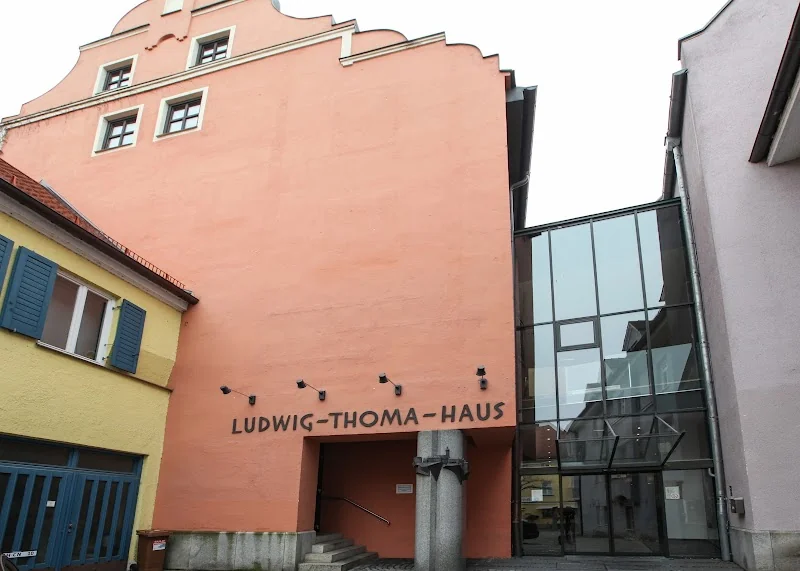
Augsburger Str. 23, Dachau
Augsburger Str. 23, 85221 Dachau, Germany
Ludwig-Thoma-Haus | Events & Program
The Ludwig-Thoma-Haus at Augsburger Straße 23 is the municipal event venue of the large district town of Dachau and has been a fixed point for theater, concerts, readings, and cultural events for decades. Thanks to its central location in the old town, it is quickly accessible on foot, by MVV bus, and by car; parking is possible in the nearby Altstadtparkgarage. The heart of the venue is the large Stockmann Hall with flexible seating arrangements and a gallery, along with the versatile Erchana Hall, the atmospheric Thiemann Vault, and three characterful rooms for workshops, rehearsals, or meetings. Modern lighting and sound technology, projector/screen, Wi-Fi, and a concert grand piano support professional events as well as club evenings or charity formats. The official seating plans provide planning security; the municipal event calendar portal consolidates dates and ticket information clearly. Those interested in the history of the Dachau cultural landscape will also discover references to significant personalities and eras in the house – from the relief in the foyer to room names that commemorate artists and historical figures. This mix of local history, contemporary facilities, and good accessibility makes the Ludwig-Thoma-Haus the first address for culture in Dachau.
Events and Program: Theater, Concerts, Readings – Current and Diverse
The program at the Ludwig-Thoma-Haus is as diverse as the city itself. The event calendar of the city of Dachau regularly features guest theater performances, concerts ranging from classical to folk and jazz, children's and youth theater, readings, charity evenings, and formats for the local cultural scene. For spring 2026, several events are announced for April, including a musical charity reading as well as theater performances and guest appearances by international formations. Such examples demonstrate the range: Sometimes an evening is aimed at family audiences, sometimes literary voices take center stage, and sometimes musical discoveries from folk to world music dominate. The great strength of the house lies in the combination of professional infrastructure and community anchoring: municipal series, local clubs, and external organizers use the spaces equally – making the program varied and accessible. For visitors, this means: In the official event calendar of the city of Dachau, it is possible to filter by date, genre, or location, so that dates at the Ludwig-Thoma-Haus can be quickly found. There, the usual ticketing options for the respective responsible organizers are also listed – from online sales systems to local advance sales points depending on the event. Since the house offers several halls and rooms, different formats can take place simultaneously or at staggered times, from children's plays in the afternoon to concerts in the evening. For families, it is particularly attractive that regularly child-friendly theater and participatory formats appear in the calendar; culture enthusiasts appreciate the readings and concert evenings in a well-accessible city location. Those planning to attend an event should pay attention to the specified entry and start times of the respective event and, for numbered seating contingents, note the seating variant indicated in the seating plan. Short-term changes are reflected in the calendar – so it's worth checking shortly before the date.
Directions & Parking: Centrally Located, MVV Bus 719/720/722 and Altstadtparkgarage
Getting to the Ludwig-Thoma-Haus is straightforward: From Dachau train station, it takes just a few minutes with the MVV bus lines 719, 720, and 722 towards the old town; nearby stops are Mittermayerstraße and Rathaus. Line 719 runs every 10 minutes during the day until about 7 PM, while the ring lines 720/722 operate in 10/20-minute intervals until about midnight. This also ensures a good public return after evening events. For those arriving by car: The Ludwig-Thoma-Haus does not have its own visitor parking (delivery traffic is possible upon request). The Altstadtparkgarage in Wieninger Straße 10 is recommended; it is about a three-minute walk to the entrance. Those who prefer to avoid the city center can use Park+Ride at the train station and continue by bus – an option that eases parking searches in the old town before larger evenings. There are several bicycle parking options available in the old town. Taxis can be organized quickly at the train station or through regional providers. Convenient for those unfamiliar with the area: The address Augsburger Straße 23 is stored in many navigation systems; the route to the old town is well signposted. Visitor groups arriving by coach should coordinate early with the organizer to arrange stopping and drop-off zones, as there may be short-term traffic regulations in the historic old town. Those wishing to arrive with minimal barriers will find short distances due to the central location and can use the nearest stops or parking options accordingly. Please note that event days in the old town lead to higher visitor numbers – plan a little extra time for parking searches and the walk from the garage to the house.
Seating Plan, Seats, and Technology: Overview of Stockmann Hall, Erchana Hall, and Thiemann Vault
The Stockmann Hall is the largest event space in the house and offers up to 394 seats (300 in the hall and 94 on the surrounding gallery) or up to 730 standing places, depending on the seating arrangement. In addition to row seating, table arrangements are possible; a concert grand piano is available. The stage has a width of approximately 7.60 meters and a depth of 4.47/4.87 meters (left/right). Official seating plans are available as PDFs for planning, as well as a Technical Rider and a DMX patch that define sound and lighting requirements, hanging points, and connections. The Erchana Hall, with approximately 173 square meters, is ideal for medium-sized readings, chamber concerts, conferences, or workshops; with row seating, up to 170 seats (with a center aisle) are possible, and up to 120 with table seating. Here, the stage is about 6.00 by 6.50 meters in size. The Thiemann Vault – about 162 square meters – impresses with its special architecture featuring columns and is suitable for atmospheric formats, receptions, and exhibitions; here, up to 120 seats can be realized. Additionally, there are three rooms: the Paula Wimmer Room (approximately 70 square meters, 22 seats with tables), the Kaspar Lorinser Room (approximately 27 square meters, 12 seats), and the Andreas Voest Room (approximately 27 square meters, 12 seats). All halls are equipped with modern lighting and sound technology, projector/screen, and Wi-Fi; both the large and medium halls each have a grand piano. Those planning as organizers benefit from the official seating plans: They show sightlines, escape routes, and exact row arrangements, helping to calculate seating contingents correctly. For row seating with a gallery, ticketing is particularly clear, as the hall capacity is clearly indicated. For conferences and receptions, it is advisable to check the table seating options to plan for catering areas, technical islands, or poster walls. For concerts with a large standing area, the Stockmann Hall can be played openly; then, a maximum occupancy of up to 730 guests is possible. In all rooms, the technical specifications from the Technical Rider are binding and should be incorporated into the production early – this includes, among other things, electrical circuits, FOH positions, hanging points, and safety regulations of the Bavarian Assembly Places Ordinance, which is available for download.
Tickets & Booking: Ways to the Ticket and Notes for Organizers
For visitors, the easiest way to the ticket is through the event calendar of the city of Dachau: For each date, the location, time, brief description, and usually also ticket/reservation information from the respective responsible organizer are provided. Depending on the production, online ticket systems, advance sales points, or box offices are used; the ticketing options are not uniform, as the Ludwig-Thoma-Haus is used by various organizers as a municipal venue. Therefore, anyone wishing to attend an event should check the entry in the calendar and – if necessary – follow the link or contact the respective provider. For groups, early reservation is worthwhile, especially for numbered seating in the Stockmann Hall. For organizers, the city of Dachau offers transparent conditions: Dachau clubs, cultural and political groups, parties, non-profit organizations, kindergartens, after-school care, and schools, as well as charity organizers can rent the rooms free of charge. For external clubs, public task bearers, churches, and the police, tiered rental prices apply; flat rates are also specified for cultural organizers, businesses, sales organizers, and banks. Additionally, room booking forms and a house and usage regulation are available as official downloads. For private celebrations, there is a special rule: They are only permitted if all three halls are booked together. Catering is freely selectable, food and drinks may be brought in or provided by external service providers; the city does not provide a kitchen or dishes, and any waste must be disposed of independently. These regulations keep the house flexible for culture and community use while providing organizers with clear planning foundations. Those needing technology, setup times, or rehearsal times should consider the information from the Technical Rider and house rules and coordinate the details early with the cultural office.
History & Special Features: From Unterbräustadel to Cultural Center
The building that today houses the Ludwig-Thoma-Haus has a turbulent history: At the beginning of the 19th century, the area belonged to the opposite inn Unterbräu; the so-called Unterbräustadel served as an event space where the Dachau Christmas plays took place between 1903 and 1906. During World War I, the Unterbräustadel became a Catholic community house and center of club life; parts of the library established since 1919 were handed over as a storage library to the Dachau concentration camp during the Nazi era. In 1933, the NSDAP took over the community house as an event venue, and later the first cinema in the city was established here. After its closure, the city of Dachau converted the building into a club and event house in 1973/74. In 1991/92, an extension was built with a complete redesign; the festive inauguration took place in October 1994. A focal point in the entrance area is the relief with the city silhouette of Dachau around a stone column, created by Karl Halt-Trossbach – it dates from the phase of redesign. The names of the rooms also refer to local cultural history: The Stockmann Hall honors the painter and honorary citizen Hermann Stockmann (1867–1938); the Thiemann Vault recalls the graphic artist and woodcut innovator Carl Thiemann (1881–1966), co-founder of the Dachau Artists' Association; the Erchana designation goes back to the noble Erchana of Dahauua, whose donation certificate from the year 805 is considered the earliest mention of Dachau. The rooms are dedicated to other personalities: Paula Wimmer (1876–1971), a painter of early expressionism; Kaspar Lorinser, the title character of an unfinished novel by Ludwig Thoma (1919/20); and Andreas Voest, a central figure from Thoma's work (1905). These references make it clear that the house is not only a stage and hall but also a place of lived memory – anchored in the artist and city history of Dachau. Today, it serves as a municipal cultural center where international guest performances, municipal series, and local initiatives come together. The content and spatial development since the 1970s is reflected in today's offerings: Professional technology, flexible room formats, and a centrally urban location combine to create an open house for many target groups.
Facilities, Service & Use: Technology, Rooms, and Practical Tips
For a successful production, the Ludwig-Thoma-Haus offers sensible standards: permanently installed lighting and sound technology, projection options with projector and screen, Wi-Fi coverage, and a grand piano in both the large and medium halls. The Stockmann Hall with gallery is suitable for larger theater and concert formats, but also for balls, presentations, or award ceremonies; the various seating arrangements (row, table, standing) allow for appropriate selection of content and atmosphere. The Erchana Hall ideally complements readings, chamber music, workshops, or conferences with its format, while the Thiemann Vault can be used particularly atmospherically for receptions, smaller concerts, or exhibitions due to its vaulted structure and columns. The three rooms complement the space offerings: With 70 square meters, the Paula Wimmer Room accommodates around 22 people at tables – ideal for committee meetings or seminars. The Kaspar Lorinser and Andreas Voest Rooms, each with around 27 square meters and 12 seats, are good retreats for meetings, coaching, or as a production office. Those planning as organizers should incorporate the official house and usage regulations; they govern, among other things, safety, fire protection, and usage times. The Assembly Places Ordinance of the Free State of Bavaria is linked as a binding basis. For technical teams, Technical Riders and DMX patches are available for download, allowing for efficient pre-coordination with external service providers. Thanks to Wi-Fi, hybrid work is also possible – for example, for online accreditations or streaming companion formats, provided these are coordinated with the cultural office on a case-by-case basis. Visitors benefit from clearly marked entrances and foyers; the hall information in program notes facilitates orientation on-site. Since the house does not provide a kitchen, it is advisable to plan solutions for food, distribution, and logistics with caterers and to incorporate waste concepts. For evening planning: Those arriving by car should drive directly to the Altstadtparkgarage and walk the short distance on foot; those taking the bus should keep an eye on the schedule. This way, entry and start can be reached comfortably – especially with numbered seating in the Stockmann Hall.
Photo Opportunities, Impressions & Location: What Visitors Want to Know in Advance
Many visitors want to get a feel for the spatial effect and atmosphere before the event. The Stockmann Hall appears open yet focused due to its gallery; the sightlines from the gallery to the stage are clear, and the parquet areas allow for both close stage experiences with row or table seating as well as wide, open standing areas at concerts. The Erchana Hall unfolds its strengths in formats that require proximity and good speech intelligibility – readings, panels, smaller ensembles. The Thiemann Vault scores with architectural character that visually supports receptions and exhibitions. For arrival, the central location in the old town offers clear advantages: Gastronomy, castle area, and pedestrian paths are close together – ideal for extended cultural evenings. First-time visitors can easily find the address via navigation devices; bus travelers orient themselves at the stops Mittermayerstraße or Rathaus. Those coming with children can check the event calendar for accompanying offers at the city library, district museum, or in the castle area before family formats. For organizers, it is advisable to view image motifs (e.g., empty seating arrangements) and room data from the seating plans in advance to align promotional materials with the hall effect. It is also sensible to compare the technical parameters in the Technical Rider with the band or ensemble production. Overall, the Ludwig-Thoma-Haus conveys the impression of a grown, community-oriented cultural place with a professional core – a house that provides space for local initiatives as well as a reliable stage for demanding guest performances.
Sources:
Show moreShow less
Ludwig-Thoma-Haus | Events & Program
The Ludwig-Thoma-Haus at Augsburger Straße 23 is the municipal event venue of the large district town of Dachau and has been a fixed point for theater, concerts, readings, and cultural events for decades. Thanks to its central location in the old town, it is quickly accessible on foot, by MVV bus, and by car; parking is possible in the nearby Altstadtparkgarage. The heart of the venue is the large Stockmann Hall with flexible seating arrangements and a gallery, along with the versatile Erchana Hall, the atmospheric Thiemann Vault, and three characterful rooms for workshops, rehearsals, or meetings. Modern lighting and sound technology, projector/screen, Wi-Fi, and a concert grand piano support professional events as well as club evenings or charity formats. The official seating plans provide planning security; the municipal event calendar portal consolidates dates and ticket information clearly. Those interested in the history of the Dachau cultural landscape will also discover references to significant personalities and eras in the house – from the relief in the foyer to room names that commemorate artists and historical figures. This mix of local history, contemporary facilities, and good accessibility makes the Ludwig-Thoma-Haus the first address for culture in Dachau.
Events and Program: Theater, Concerts, Readings – Current and Diverse
The program at the Ludwig-Thoma-Haus is as diverse as the city itself. The event calendar of the city of Dachau regularly features guest theater performances, concerts ranging from classical to folk and jazz, children's and youth theater, readings, charity evenings, and formats for the local cultural scene. For spring 2026, several events are announced for April, including a musical charity reading as well as theater performances and guest appearances by international formations. Such examples demonstrate the range: Sometimes an evening is aimed at family audiences, sometimes literary voices take center stage, and sometimes musical discoveries from folk to world music dominate. The great strength of the house lies in the combination of professional infrastructure and community anchoring: municipal series, local clubs, and external organizers use the spaces equally – making the program varied and accessible. For visitors, this means: In the official event calendar of the city of Dachau, it is possible to filter by date, genre, or location, so that dates at the Ludwig-Thoma-Haus can be quickly found. There, the usual ticketing options for the respective responsible organizers are also listed – from online sales systems to local advance sales points depending on the event. Since the house offers several halls and rooms, different formats can take place simultaneously or at staggered times, from children's plays in the afternoon to concerts in the evening. For families, it is particularly attractive that regularly child-friendly theater and participatory formats appear in the calendar; culture enthusiasts appreciate the readings and concert evenings in a well-accessible city location. Those planning to attend an event should pay attention to the specified entry and start times of the respective event and, for numbered seating contingents, note the seating variant indicated in the seating plan. Short-term changes are reflected in the calendar – so it's worth checking shortly before the date.
Directions & Parking: Centrally Located, MVV Bus 719/720/722 and Altstadtparkgarage
Getting to the Ludwig-Thoma-Haus is straightforward: From Dachau train station, it takes just a few minutes with the MVV bus lines 719, 720, and 722 towards the old town; nearby stops are Mittermayerstraße and Rathaus. Line 719 runs every 10 minutes during the day until about 7 PM, while the ring lines 720/722 operate in 10/20-minute intervals until about midnight. This also ensures a good public return after evening events. For those arriving by car: The Ludwig-Thoma-Haus does not have its own visitor parking (delivery traffic is possible upon request). The Altstadtparkgarage in Wieninger Straße 10 is recommended; it is about a three-minute walk to the entrance. Those who prefer to avoid the city center can use Park+Ride at the train station and continue by bus – an option that eases parking searches in the old town before larger evenings. There are several bicycle parking options available in the old town. Taxis can be organized quickly at the train station or through regional providers. Convenient for those unfamiliar with the area: The address Augsburger Straße 23 is stored in many navigation systems; the route to the old town is well signposted. Visitor groups arriving by coach should coordinate early with the organizer to arrange stopping and drop-off zones, as there may be short-term traffic regulations in the historic old town. Those wishing to arrive with minimal barriers will find short distances due to the central location and can use the nearest stops or parking options accordingly. Please note that event days in the old town lead to higher visitor numbers – plan a little extra time for parking searches and the walk from the garage to the house.
Seating Plan, Seats, and Technology: Overview of Stockmann Hall, Erchana Hall, and Thiemann Vault
The Stockmann Hall is the largest event space in the house and offers up to 394 seats (300 in the hall and 94 on the surrounding gallery) or up to 730 standing places, depending on the seating arrangement. In addition to row seating, table arrangements are possible; a concert grand piano is available. The stage has a width of approximately 7.60 meters and a depth of 4.47/4.87 meters (left/right). Official seating plans are available as PDFs for planning, as well as a Technical Rider and a DMX patch that define sound and lighting requirements, hanging points, and connections. The Erchana Hall, with approximately 173 square meters, is ideal for medium-sized readings, chamber concerts, conferences, or workshops; with row seating, up to 170 seats (with a center aisle) are possible, and up to 120 with table seating. Here, the stage is about 6.00 by 6.50 meters in size. The Thiemann Vault – about 162 square meters – impresses with its special architecture featuring columns and is suitable for atmospheric formats, receptions, and exhibitions; here, up to 120 seats can be realized. Additionally, there are three rooms: the Paula Wimmer Room (approximately 70 square meters, 22 seats with tables), the Kaspar Lorinser Room (approximately 27 square meters, 12 seats), and the Andreas Voest Room (approximately 27 square meters, 12 seats). All halls are equipped with modern lighting and sound technology, projector/screen, and Wi-Fi; both the large and medium halls each have a grand piano. Those planning as organizers benefit from the official seating plans: They show sightlines, escape routes, and exact row arrangements, helping to calculate seating contingents correctly. For row seating with a gallery, ticketing is particularly clear, as the hall capacity is clearly indicated. For conferences and receptions, it is advisable to check the table seating options to plan for catering areas, technical islands, or poster walls. For concerts with a large standing area, the Stockmann Hall can be played openly; then, a maximum occupancy of up to 730 guests is possible. In all rooms, the technical specifications from the Technical Rider are binding and should be incorporated into the production early – this includes, among other things, electrical circuits, FOH positions, hanging points, and safety regulations of the Bavarian Assembly Places Ordinance, which is available for download.
Tickets & Booking: Ways to the Ticket and Notes for Organizers
For visitors, the easiest way to the ticket is through the event calendar of the city of Dachau: For each date, the location, time, brief description, and usually also ticket/reservation information from the respective responsible organizer are provided. Depending on the production, online ticket systems, advance sales points, or box offices are used; the ticketing options are not uniform, as the Ludwig-Thoma-Haus is used by various organizers as a municipal venue. Therefore, anyone wishing to attend an event should check the entry in the calendar and – if necessary – follow the link or contact the respective provider. For groups, early reservation is worthwhile, especially for numbered seating in the Stockmann Hall. For organizers, the city of Dachau offers transparent conditions: Dachau clubs, cultural and political groups, parties, non-profit organizations, kindergartens, after-school care, and schools, as well as charity organizers can rent the rooms free of charge. For external clubs, public task bearers, churches, and the police, tiered rental prices apply; flat rates are also specified for cultural organizers, businesses, sales organizers, and banks. Additionally, room booking forms and a house and usage regulation are available as official downloads. For private celebrations, there is a special rule: They are only permitted if all three halls are booked together. Catering is freely selectable, food and drinks may be brought in or provided by external service providers; the city does not provide a kitchen or dishes, and any waste must be disposed of independently. These regulations keep the house flexible for culture and community use while providing organizers with clear planning foundations. Those needing technology, setup times, or rehearsal times should consider the information from the Technical Rider and house rules and coordinate the details early with the cultural office.
History & Special Features: From Unterbräustadel to Cultural Center
The building that today houses the Ludwig-Thoma-Haus has a turbulent history: At the beginning of the 19th century, the area belonged to the opposite inn Unterbräu; the so-called Unterbräustadel served as an event space where the Dachau Christmas plays took place between 1903 and 1906. During World War I, the Unterbräustadel became a Catholic community house and center of club life; parts of the library established since 1919 were handed over as a storage library to the Dachau concentration camp during the Nazi era. In 1933, the NSDAP took over the community house as an event venue, and later the first cinema in the city was established here. After its closure, the city of Dachau converted the building into a club and event house in 1973/74. In 1991/92, an extension was built with a complete redesign; the festive inauguration took place in October 1994. A focal point in the entrance area is the relief with the city silhouette of Dachau around a stone column, created by Karl Halt-Trossbach – it dates from the phase of redesign. The names of the rooms also refer to local cultural history: The Stockmann Hall honors the painter and honorary citizen Hermann Stockmann (1867–1938); the Thiemann Vault recalls the graphic artist and woodcut innovator Carl Thiemann (1881–1966), co-founder of the Dachau Artists' Association; the Erchana designation goes back to the noble Erchana of Dahauua, whose donation certificate from the year 805 is considered the earliest mention of Dachau. The rooms are dedicated to other personalities: Paula Wimmer (1876–1971), a painter of early expressionism; Kaspar Lorinser, the title character of an unfinished novel by Ludwig Thoma (1919/20); and Andreas Voest, a central figure from Thoma's work (1905). These references make it clear that the house is not only a stage and hall but also a place of lived memory – anchored in the artist and city history of Dachau. Today, it serves as a municipal cultural center where international guest performances, municipal series, and local initiatives come together. The content and spatial development since the 1970s is reflected in today's offerings: Professional technology, flexible room formats, and a centrally urban location combine to create an open house for many target groups.
Facilities, Service & Use: Technology, Rooms, and Practical Tips
For a successful production, the Ludwig-Thoma-Haus offers sensible standards: permanently installed lighting and sound technology, projection options with projector and screen, Wi-Fi coverage, and a grand piano in both the large and medium halls. The Stockmann Hall with gallery is suitable for larger theater and concert formats, but also for balls, presentations, or award ceremonies; the various seating arrangements (row, table, standing) allow for appropriate selection of content and atmosphere. The Erchana Hall ideally complements readings, chamber music, workshops, or conferences with its format, while the Thiemann Vault can be used particularly atmospherically for receptions, smaller concerts, or exhibitions due to its vaulted structure and columns. The three rooms complement the space offerings: With 70 square meters, the Paula Wimmer Room accommodates around 22 people at tables – ideal for committee meetings or seminars. The Kaspar Lorinser and Andreas Voest Rooms, each with around 27 square meters and 12 seats, are good retreats for meetings, coaching, or as a production office. Those planning as organizers should incorporate the official house and usage regulations; they govern, among other things, safety, fire protection, and usage times. The Assembly Places Ordinance of the Free State of Bavaria is linked as a binding basis. For technical teams, Technical Riders and DMX patches are available for download, allowing for efficient pre-coordination with external service providers. Thanks to Wi-Fi, hybrid work is also possible – for example, for online accreditations or streaming companion formats, provided these are coordinated with the cultural office on a case-by-case basis. Visitors benefit from clearly marked entrances and foyers; the hall information in program notes facilitates orientation on-site. Since the house does not provide a kitchen, it is advisable to plan solutions for food, distribution, and logistics with caterers and to incorporate waste concepts. For evening planning: Those arriving by car should drive directly to the Altstadtparkgarage and walk the short distance on foot; those taking the bus should keep an eye on the schedule. This way, entry and start can be reached comfortably – especially with numbered seating in the Stockmann Hall.
Photo Opportunities, Impressions & Location: What Visitors Want to Know in Advance
Many visitors want to get a feel for the spatial effect and atmosphere before the event. The Stockmann Hall appears open yet focused due to its gallery; the sightlines from the gallery to the stage are clear, and the parquet areas allow for both close stage experiences with row or table seating as well as wide, open standing areas at concerts. The Erchana Hall unfolds its strengths in formats that require proximity and good speech intelligibility – readings, panels, smaller ensembles. The Thiemann Vault scores with architectural character that visually supports receptions and exhibitions. For arrival, the central location in the old town offers clear advantages: Gastronomy, castle area, and pedestrian paths are close together – ideal for extended cultural evenings. First-time visitors can easily find the address via navigation devices; bus travelers orient themselves at the stops Mittermayerstraße or Rathaus. Those coming with children can check the event calendar for accompanying offers at the city library, district museum, or in the castle area before family formats. For organizers, it is advisable to view image motifs (e.g., empty seating arrangements) and room data from the seating plans in advance to align promotional materials with the hall effect. It is also sensible to compare the technical parameters in the Technical Rider with the band or ensemble production. Overall, the Ludwig-Thoma-Haus conveys the impression of a grown, community-oriented cultural place with a professional core – a house that provides space for local initiatives as well as a reliable stage for demanding guest performances.
Sources:
Ludwig-Thoma-Haus | Events & Program
The Ludwig-Thoma-Haus at Augsburger Straße 23 is the municipal event venue of the large district town of Dachau and has been a fixed point for theater, concerts, readings, and cultural events for decades. Thanks to its central location in the old town, it is quickly accessible on foot, by MVV bus, and by car; parking is possible in the nearby Altstadtparkgarage. The heart of the venue is the large Stockmann Hall with flexible seating arrangements and a gallery, along with the versatile Erchana Hall, the atmospheric Thiemann Vault, and three characterful rooms for workshops, rehearsals, or meetings. Modern lighting and sound technology, projector/screen, Wi-Fi, and a concert grand piano support professional events as well as club evenings or charity formats. The official seating plans provide planning security; the municipal event calendar portal consolidates dates and ticket information clearly. Those interested in the history of the Dachau cultural landscape will also discover references to significant personalities and eras in the house – from the relief in the foyer to room names that commemorate artists and historical figures. This mix of local history, contemporary facilities, and good accessibility makes the Ludwig-Thoma-Haus the first address for culture in Dachau.
Events and Program: Theater, Concerts, Readings – Current and Diverse
The program at the Ludwig-Thoma-Haus is as diverse as the city itself. The event calendar of the city of Dachau regularly features guest theater performances, concerts ranging from classical to folk and jazz, children's and youth theater, readings, charity evenings, and formats for the local cultural scene. For spring 2026, several events are announced for April, including a musical charity reading as well as theater performances and guest appearances by international formations. Such examples demonstrate the range: Sometimes an evening is aimed at family audiences, sometimes literary voices take center stage, and sometimes musical discoveries from folk to world music dominate. The great strength of the house lies in the combination of professional infrastructure and community anchoring: municipal series, local clubs, and external organizers use the spaces equally – making the program varied and accessible. For visitors, this means: In the official event calendar of the city of Dachau, it is possible to filter by date, genre, or location, so that dates at the Ludwig-Thoma-Haus can be quickly found. There, the usual ticketing options for the respective responsible organizers are also listed – from online sales systems to local advance sales points depending on the event. Since the house offers several halls and rooms, different formats can take place simultaneously or at staggered times, from children's plays in the afternoon to concerts in the evening. For families, it is particularly attractive that regularly child-friendly theater and participatory formats appear in the calendar; culture enthusiasts appreciate the readings and concert evenings in a well-accessible city location. Those planning to attend an event should pay attention to the specified entry and start times of the respective event and, for numbered seating contingents, note the seating variant indicated in the seating plan. Short-term changes are reflected in the calendar – so it's worth checking shortly before the date.
Directions & Parking: Centrally Located, MVV Bus 719/720/722 and Altstadtparkgarage
Getting to the Ludwig-Thoma-Haus is straightforward: From Dachau train station, it takes just a few minutes with the MVV bus lines 719, 720, and 722 towards the old town; nearby stops are Mittermayerstraße and Rathaus. Line 719 runs every 10 minutes during the day until about 7 PM, while the ring lines 720/722 operate in 10/20-minute intervals until about midnight. This also ensures a good public return after evening events. For those arriving by car: The Ludwig-Thoma-Haus does not have its own visitor parking (delivery traffic is possible upon request). The Altstadtparkgarage in Wieninger Straße 10 is recommended; it is about a three-minute walk to the entrance. Those who prefer to avoid the city center can use Park+Ride at the train station and continue by bus – an option that eases parking searches in the old town before larger evenings. There are several bicycle parking options available in the old town. Taxis can be organized quickly at the train station or through regional providers. Convenient for those unfamiliar with the area: The address Augsburger Straße 23 is stored in many navigation systems; the route to the old town is well signposted. Visitor groups arriving by coach should coordinate early with the organizer to arrange stopping and drop-off zones, as there may be short-term traffic regulations in the historic old town. Those wishing to arrive with minimal barriers will find short distances due to the central location and can use the nearest stops or parking options accordingly. Please note that event days in the old town lead to higher visitor numbers – plan a little extra time for parking searches and the walk from the garage to the house.
Seating Plan, Seats, and Technology: Overview of Stockmann Hall, Erchana Hall, and Thiemann Vault
The Stockmann Hall is the largest event space in the house and offers up to 394 seats (300 in the hall and 94 on the surrounding gallery) or up to 730 standing places, depending on the seating arrangement. In addition to row seating, table arrangements are possible; a concert grand piano is available. The stage has a width of approximately 7.60 meters and a depth of 4.47/4.87 meters (left/right). Official seating plans are available as PDFs for planning, as well as a Technical Rider and a DMX patch that define sound and lighting requirements, hanging points, and connections. The Erchana Hall, with approximately 173 square meters, is ideal for medium-sized readings, chamber concerts, conferences, or workshops; with row seating, up to 170 seats (with a center aisle) are possible, and up to 120 with table seating. Here, the stage is about 6.00 by 6.50 meters in size. The Thiemann Vault – about 162 square meters – impresses with its special architecture featuring columns and is suitable for atmospheric formats, receptions, and exhibitions; here, up to 120 seats can be realized. Additionally, there are three rooms: the Paula Wimmer Room (approximately 70 square meters, 22 seats with tables), the Kaspar Lorinser Room (approximately 27 square meters, 12 seats), and the Andreas Voest Room (approximately 27 square meters, 12 seats). All halls are equipped with modern lighting and sound technology, projector/screen, and Wi-Fi; both the large and medium halls each have a grand piano. Those planning as organizers benefit from the official seating plans: They show sightlines, escape routes, and exact row arrangements, helping to calculate seating contingents correctly. For row seating with a gallery, ticketing is particularly clear, as the hall capacity is clearly indicated. For conferences and receptions, it is advisable to check the table seating options to plan for catering areas, technical islands, or poster walls. For concerts with a large standing area, the Stockmann Hall can be played openly; then, a maximum occupancy of up to 730 guests is possible. In all rooms, the technical specifications from the Technical Rider are binding and should be incorporated into the production early – this includes, among other things, electrical circuits, FOH positions, hanging points, and safety regulations of the Bavarian Assembly Places Ordinance, which is available for download.
Tickets & Booking: Ways to the Ticket and Notes for Organizers
For visitors, the easiest way to the ticket is through the event calendar of the city of Dachau: For each date, the location, time, brief description, and usually also ticket/reservation information from the respective responsible organizer are provided. Depending on the production, online ticket systems, advance sales points, or box offices are used; the ticketing options are not uniform, as the Ludwig-Thoma-Haus is used by various organizers as a municipal venue. Therefore, anyone wishing to attend an event should check the entry in the calendar and – if necessary – follow the link or contact the respective provider. For groups, early reservation is worthwhile, especially for numbered seating in the Stockmann Hall. For organizers, the city of Dachau offers transparent conditions: Dachau clubs, cultural and political groups, parties, non-profit organizations, kindergartens, after-school care, and schools, as well as charity organizers can rent the rooms free of charge. For external clubs, public task bearers, churches, and the police, tiered rental prices apply; flat rates are also specified for cultural organizers, businesses, sales organizers, and banks. Additionally, room booking forms and a house and usage regulation are available as official downloads. For private celebrations, there is a special rule: They are only permitted if all three halls are booked together. Catering is freely selectable, food and drinks may be brought in or provided by external service providers; the city does not provide a kitchen or dishes, and any waste must be disposed of independently. These regulations keep the house flexible for culture and community use while providing organizers with clear planning foundations. Those needing technology, setup times, or rehearsal times should consider the information from the Technical Rider and house rules and coordinate the details early with the cultural office.
History & Special Features: From Unterbräustadel to Cultural Center
The building that today houses the Ludwig-Thoma-Haus has a turbulent history: At the beginning of the 19th century, the area belonged to the opposite inn Unterbräu; the so-called Unterbräustadel served as an event space where the Dachau Christmas plays took place between 1903 and 1906. During World War I, the Unterbräustadel became a Catholic community house and center of club life; parts of the library established since 1919 were handed over as a storage library to the Dachau concentration camp during the Nazi era. In 1933, the NSDAP took over the community house as an event venue, and later the first cinema in the city was established here. After its closure, the city of Dachau converted the building into a club and event house in 1973/74. In 1991/92, an extension was built with a complete redesign; the festive inauguration took place in October 1994. A focal point in the entrance area is the relief with the city silhouette of Dachau around a stone column, created by Karl Halt-Trossbach – it dates from the phase of redesign. The names of the rooms also refer to local cultural history: The Stockmann Hall honors the painter and honorary citizen Hermann Stockmann (1867–1938); the Thiemann Vault recalls the graphic artist and woodcut innovator Carl Thiemann (1881–1966), co-founder of the Dachau Artists' Association; the Erchana designation goes back to the noble Erchana of Dahauua, whose donation certificate from the year 805 is considered the earliest mention of Dachau. The rooms are dedicated to other personalities: Paula Wimmer (1876–1971), a painter of early expressionism; Kaspar Lorinser, the title character of an unfinished novel by Ludwig Thoma (1919/20); and Andreas Voest, a central figure from Thoma's work (1905). These references make it clear that the house is not only a stage and hall but also a place of lived memory – anchored in the artist and city history of Dachau. Today, it serves as a municipal cultural center where international guest performances, municipal series, and local initiatives come together. The content and spatial development since the 1970s is reflected in today's offerings: Professional technology, flexible room formats, and a centrally urban location combine to create an open house for many target groups.
Facilities, Service & Use: Technology, Rooms, and Practical Tips
For a successful production, the Ludwig-Thoma-Haus offers sensible standards: permanently installed lighting and sound technology, projection options with projector and screen, Wi-Fi coverage, and a grand piano in both the large and medium halls. The Stockmann Hall with gallery is suitable for larger theater and concert formats, but also for balls, presentations, or award ceremonies; the various seating arrangements (row, table, standing) allow for appropriate selection of content and atmosphere. The Erchana Hall ideally complements readings, chamber music, workshops, or conferences with its format, while the Thiemann Vault can be used particularly atmospherically for receptions, smaller concerts, or exhibitions due to its vaulted structure and columns. The three rooms complement the space offerings: With 70 square meters, the Paula Wimmer Room accommodates around 22 people at tables – ideal for committee meetings or seminars. The Kaspar Lorinser and Andreas Voest Rooms, each with around 27 square meters and 12 seats, are good retreats for meetings, coaching, or as a production office. Those planning as organizers should incorporate the official house and usage regulations; they govern, among other things, safety, fire protection, and usage times. The Assembly Places Ordinance of the Free State of Bavaria is linked as a binding basis. For technical teams, Technical Riders and DMX patches are available for download, allowing for efficient pre-coordination with external service providers. Thanks to Wi-Fi, hybrid work is also possible – for example, for online accreditations or streaming companion formats, provided these are coordinated with the cultural office on a case-by-case basis. Visitors benefit from clearly marked entrances and foyers; the hall information in program notes facilitates orientation on-site. Since the house does not provide a kitchen, it is advisable to plan solutions for food, distribution, and logistics with caterers and to incorporate waste concepts. For evening planning: Those arriving by car should drive directly to the Altstadtparkgarage and walk the short distance on foot; those taking the bus should keep an eye on the schedule. This way, entry and start can be reached comfortably – especially with numbered seating in the Stockmann Hall.
Photo Opportunities, Impressions & Location: What Visitors Want to Know in Advance
Many visitors want to get a feel for the spatial effect and atmosphere before the event. The Stockmann Hall appears open yet focused due to its gallery; the sightlines from the gallery to the stage are clear, and the parquet areas allow for both close stage experiences with row or table seating as well as wide, open standing areas at concerts. The Erchana Hall unfolds its strengths in formats that require proximity and good speech intelligibility – readings, panels, smaller ensembles. The Thiemann Vault scores with architectural character that visually supports receptions and exhibitions. For arrival, the central location in the old town offers clear advantages: Gastronomy, castle area, and pedestrian paths are close together – ideal for extended cultural evenings. First-time visitors can easily find the address via navigation devices; bus travelers orient themselves at the stops Mittermayerstraße or Rathaus. Those coming with children can check the event calendar for accompanying offers at the city library, district museum, or in the castle area before family formats. For organizers, it is advisable to view image motifs (e.g., empty seating arrangements) and room data from the seating plans in advance to align promotional materials with the hall effect. It is also sensible to compare the technical parameters in the Technical Rider with the band or ensemble production. Overall, the Ludwig-Thoma-Haus conveys the impression of a grown, community-oriented cultural place with a professional core – a house that provides space for local initiatives as well as a reliable stage for demanding guest performances.
Sources:
Frequently Asked Questions
Reviews
Plamen Margenski
15. August 2017
Nice and big place for parties
Lydya Sonya
4. December 2024
Superb
Kwibi Handy
5. March 2026
Great event Blood Trails#True Crime
My Bigbuddha
19. October 2023
It was a beautiful concert! The acoustics were good, and the crowd was just right. All in all, a lovely evening. The only downside...the hard wooden chairs. They could use some cushioning.
Wan Da (WANDA)
10. May 2022
Everything was perfect. The only suggestion for improvement: as an organizer, you have to do all the seating yourself, meaning you have to lug the heavy tables and chairs into the desired positions and then put them away again at the end of the event. It would be nice if there was at least the option to get help with this.