
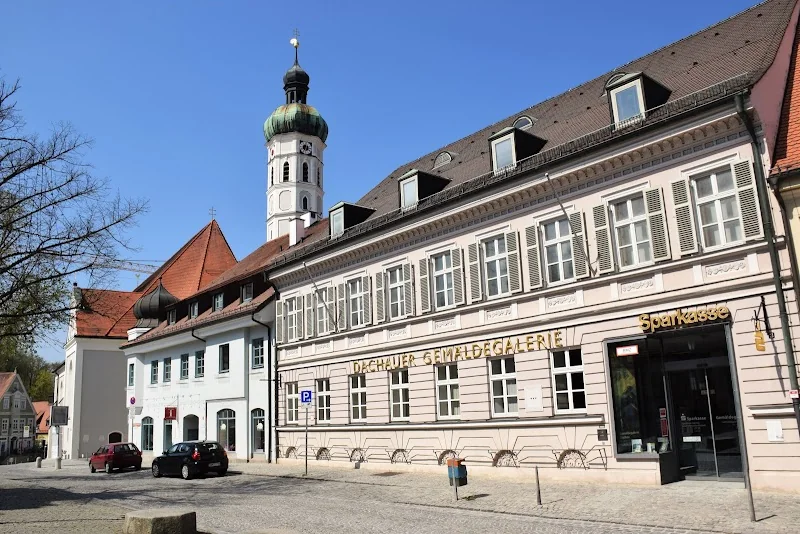
Konrad-Adenauer-Straße 3, Dachau
Konrad-Adenauer-Straße 3, 85221 Dachau, Germany
Gallery Dachau | Opening Hours & Admission Prices
The Gallery Dachau is the heart of the famous artist colony north of Munich. In the atmospheric old town opposite the town hall, it presents around 200 paintings as well as selected sculptures, impressively documenting the development of Dachau's landscape and genre painting from the 19th century to well into the 20th century. The permanent collection is complemented by changing special exhibitions that expand historical references and open international perspectives. Thanks to its central location at Konrad-Adenauer-Straße 3, the gallery is easily accessible – whether by S-Bahn (line S2) plus city bus to the old town or by car with parking options in nearby parking garages. Practical visitor information such as opening hours, admission prices, combo and annual tickets, as well as photography rules, are transparently regulated. This page consolidates all relevant topics – from the current exhibition to opening hours and ticket options to directions, parking, and services – so that your visit can be planned, relaxed, and inspiring.
Opening Hours and Admission Prices of the Gallery Dachau
The Gallery Dachau is user-friendly and clearly structured: From Tuesday to Friday, the doors open between 11 AM and 5 PM, on weekends and public holidays from 1 PM to 5 PM. This provides ample time to experience the permanent collection and any special exhibitions in peace – whether as a targeted detour in the old town or as a cultural highlight of a day trip from Munich. Like many museums, there are designated closing days: Shrove Tuesday, Good Friday and Saturday, as well as the Christmas holidays on December 24, 25, and 31. This regulation creates planning security and helps visitors, especially during holiday or festive times, to optimally time their visit.
The ticketing model at the Gallery Dachau is simple and fair. The day ticket costs 7 euros for adults. Discounts are available for trainees, students, and people with disabilities; here the price is 5 euros. Children under 6 years have free admission – a family-friendly approach that makes the visit attractive for young families. Families also benefit from a special family ticket (2 adults and up to 3 children): During special exhibitions, it costs 12 euros, otherwise 9 euros. Those who want to experience the cultural diversity of Dachau even more intensively can choose the family combo ticket with the nearby district museum. Additionally, there are combo tickets for both houses (adults 10 euros, reduced 8 euros; the reduced price applies between special exhibitions) as well as an annual ticket, which is particularly exciting for return visitors and art lovers.
Important to know for quick planning: In the houses of the Dachau Galleries and Museums Association, only cash payment is possible. This applies to day tickets as well as family and combo tickets or the purchase of catalogs. Groups of 10 or more pay 6 euros per person in the Gallery during special exhibitions, otherwise 4 euros. For school classes, the admission is particularly low-threshold: 1 euro per student, accompanying persons are free – this promotes cultural education and makes the gallery particularly interesting for class trips or project weeks. Overall, there is a consistently visitor-oriented pricing and opening hours structure that supports both spontaneous visits and planned group offers.
Current Special Exhibition: Paths of Impressionism – The Slovenian Modern and Dachau
As a vibrant exhibition venue, the Gallery Dachau consciously sets thematic accents. An impressive example of this is the current exhibition “Paths of Impressionism – The Slovenian Modern and Dachau,” which can be seen from November 28, 2025, to April 12, 2026. This special exhibition bridges the traditional Dachau artist colony and Slovenian modernism: Many young Slovenian artists sought inspiration, new painting approaches, and artistic community around 1900 in the art city of Munich and in nearby Dachau. In the Dachau moor landscape and in the special, diffuse light of the region, they found impulses that sustainably shaped their style.
The exhibition was created in cooperation with the National Gallery of Slovenia and the Slovenian Cultural Center SKICA Berlin, bringing significant works to Germany for the first time in this form. The focus is on impressionistic landscapes, characterful portraits, and paintings that make visible the societal upheavals of that time. The perspective expands from the Dachau context to a European perspective: How did ideas, techniques, and themes migrate between art centers? What role did places like Dachau play as catalysts for aesthetic developments? With finely curated groups of works, explanatory texts, and dialogical comparisons, the exhibition succeeds in not only asserting historical connections but also making them palpable in the viewing experience.
Particular attention deserves the accompanying, richly illustrated catalog (bilingual German/English), which is available at the museum's cash desk and deepens the content. It invites visitors to reflect on what they have seen at home or to further explore the topic in teaching and art historical research. By the way: Those who appreciate the diverse formats of the Dachau Galleries and Museums may remember the much-noted thematic series “BLICK.PUNKT. What Looks Tell,” which ran in the Gallery Dachau until October 5, 2025, celebrating close observation with guided tours and evening events. Such curatorial settings show that the Gallery Dachau continually sheds new light on its collection and embeds it in larger, current discourses on perception, modernity, and European cultural history.
Address, Directions & Parking in the Old Town of Dachau
The Gallery Dachau is located in the midst of the historic old town: Konrad-Adenauer-Straße 3, 85221 Dachau. The surroundings are characterized by historical ensembles, winding alleys, and squares – an atmosphere that many visitors already experience on their way to the museum, immersing them in the world of the artist colony. Particularly practical: The gallery is centrally located opposite the town hall, making it easy to combine the visit with a stroll through the old town, a café visit, or a detour to Dachau Palace.
Traveling by public transport is comfortable: From Munich Central Station, the S-Bahn line S2 travels directly to Dachau station without transfers, taking about 20 minutes. From there, the city bus 719 operates on weekdays and Saturdays until 2 PM at 10-minute intervals to the old town. On Sundays and public holidays, lines 720 and 722 also operate. Those who prefer to walk can reach the Gallery from the station in about 15 minutes – a pleasant route that already provides initial impressions of the city. For cyclists, combining with a tour on regional bike paths is worthwhile; the city and the museum's website refer to relevant information.
Dachau is also excellently connected by car, via the A8 (exit Dachau–Fürstenfeldbruck), A9/A92 (exit Oberschleißheim/Dachau), and the A99 motorway ring (exit Munich-Ludwigsfeld). Important for parking in the old town: There is a parking disc requirement on weekdays from 9 AM to 6 PM and on Saturdays from 8 AM to 12 PM with a maximum parking duration of 90 minutes. For longer museum visits and old town strolls, parking garages like the Altstadtgarage are recommended; additionally, there are extra parking spaces in the surrounding area. This combination – excellent public transport connections, short distances, and clearly regulated parking options – makes the visit planable, even during peak times or at special exhibitions with increased demand.
Photography in the Gallery Dachau: Rules for Photos & Social Media
The Gallery Dachau promotes an open, contemporary visitor culture – this includes a transparent photography concept. Individuals are allowed to take photos and videos in the exhibition rooms as long as they refrain from using flash, tripods, and selfie sticks. This rule protects the artworks and ensures that other guests can enjoy the experience undisturbed. Those who share impressions on social media should pay attention to personal rights: Other visitors and staff may only be visibly depicted with their explicit consent. For scientific, editorial, or commercial purposes, prior written permission from management is required.
Additional requirements may apply during special exhibitions – for example, if lenders define specific usage restrictions. Such exceptions are clearly marked on-site. With this approach, the Gallery combines the protection of cultural assets with the desire to make art experienceable and enable digital participation. Those who enjoy photography will also appreciate the spatial qualities of the gallery: The collection on the first floor unfolds in a calm, clear sequence of rooms; the modern special exhibition area on the second floor (since the renovation in 2005) offers excellent conditions for changing presentations. A special feature is the rooftop terrace high above the old town, which allows for perspective changes and rounds off the visitor experience – a place where the spirit of the artist colony connects with the present, without photographers needing to rely on flash.
Collection of the Artist Colony: Highlights, Number of Works, and History
A visit to the permanent exhibition is a journey into the heyday of the Dachau artist colony around 1900. Around 200 works – mostly paintings, supplemented by selected sculptures – trace the development of landscape painting: from the first discovery of the Dachau moor in the mid-19th century to movements that foreshadow modernity in the early 20th century. The collection impressively shows how painters were guided by nature observation and the special light of the region. Names like Eduard Schleich the Elder, Christian Morgenstern, Carl Spitzweg, Max Liebermann, Lovis Corinth, Leopold von Kalckreuth, and Fritz von Uhde exemplify the artistic quality and the diverse positions that converged in Dachau.
A key role was played by Adolf Hölzel, Ludwig Dill, and Arthur Langhammer. With an exhibition in Berlin in 1898, they brought the ideas of Dachau to a wider audience. Their search for new forms of expression and painterly orders paved the way for abstract painting and sustainably influenced the art of the 20th century. The Gallery Dachau illustrates this upheaval not only with individual works; it makes it experienceable in thematic contexts: plein air painting, color and light studies, the relationship between landscape and figure, the influence of Munich as an art metropolis.
The history of the museum itself is also part of this narrative. In 1908, the first gallery was opened in the palace – an early commitment of the city to its artistic identity. The current Gallery Dachau in the old town has existed since 1985; since 1988, the Dachau Galleries and Museums Association has been responsible for its management. The renovation in 2005 created a modern special exhibition area and a rooftop terrace, making the gallery spatially and thematically more flexible. The institution repeatedly opens its view beyond Dachau: Special exhibitions make relationships with other artist colonies and European modernism visible. This broad horizon – regionally anchored, internationally connected – is what makes the Gallery Dachau particularly appealing.
Tickets, On-Site Services & Digital Offers: How to Plan Your Visit
For ticket purchases, a short stop at the museum's cash desk is sufficient – please note that only cash payment is possible in the houses of the association. Those coming with family can use the family ticket (12 euros during special exhibitions, otherwise 9 euros). Particularly attractive are the combo tickets with the district museum, which allow visits to both houses at discounted prices within twelve months – ideal for those who want to first discover the permanent collection and later return for a special exhibition. For groups of 10 or more, reduced rates apply; school classes pay 1 euro per student, and the accompanying person is free. This makes cultural education planable – whether for school classes, clubs, companies, or groups of friends.
The Gallery Dachau is partially accessible for people with mobility impairments, wheelchair users, visually impaired individuals, and the blind. The team ensures a friendly, respectful visitor atmosphere; the house rules summarize the most important regulations from safety to cloakroom to photography. Those who want to deepen their visit can use the official app “Dachau Galleries and Museums” (German/English). It offers thematic tours, background texts, audio content, and materials for school classes – a useful tool for both preparing and following up on the visit. Additionally, catalogs for major exhibitions are regularly published, available at the cash desk, extending the engagement with the content.
Another tip: Combine the Gallery with a detour to the neighboring district museum. The paths are short, and the themes complement each other – art history here, cultural and everyday history there. Those arriving by public transport can skip the parking search; from Dachau station, the city bus runs frequently to the old town, and on Sundays, other lines provide the connection. If you do come by car, it’s best to plan for the 90-minute parking disc rule and use parking garages for longer stays. All these services, tips, and offers make it clear: The Gallery Dachau sees itself as an open house for art and a welcoming place for all generations – rooted in history, open to new perspectives.
Sources:
- Dachau Galleries and Museums – Visitor Information (Opening Hours, Tickets)
- Dachau Galleries and Museums – Directions (Public Transport, Parking Regulations Old Town)
- Dachau Galleries and Museums – Gallery (Permanent Exhibition, History)
- Dachau Galleries and Museums – Current Exhibition “Paths of Impressionism”
- House Rules of the Dachau Galleries and Museums (Photography & Filming)
- Cultural Portal Bavaria – Newsletter 09/2025 (“BLICK.PUNKT.” in the Gallery Dachau)
- App “Dachau Galleries and Museums” – App Store (DE/EN Content)
- City of Dachau – Municipal Traffic Monitoring (Old Town: Parking & Altstadtgarage)
Show moreShow less
Gallery Dachau | Opening Hours & Admission Prices
The Gallery Dachau is the heart of the famous artist colony north of Munich. In the atmospheric old town opposite the town hall, it presents around 200 paintings as well as selected sculptures, impressively documenting the development of Dachau's landscape and genre painting from the 19th century to well into the 20th century. The permanent collection is complemented by changing special exhibitions that expand historical references and open international perspectives. Thanks to its central location at Konrad-Adenauer-Straße 3, the gallery is easily accessible – whether by S-Bahn (line S2) plus city bus to the old town or by car with parking options in nearby parking garages. Practical visitor information such as opening hours, admission prices, combo and annual tickets, as well as photography rules, are transparently regulated. This page consolidates all relevant topics – from the current exhibition to opening hours and ticket options to directions, parking, and services – so that your visit can be planned, relaxed, and inspiring.
Opening Hours and Admission Prices of the Gallery Dachau
The Gallery Dachau is user-friendly and clearly structured: From Tuesday to Friday, the doors open between 11 AM and 5 PM, on weekends and public holidays from 1 PM to 5 PM. This provides ample time to experience the permanent collection and any special exhibitions in peace – whether as a targeted detour in the old town or as a cultural highlight of a day trip from Munich. Like many museums, there are designated closing days: Shrove Tuesday, Good Friday and Saturday, as well as the Christmas holidays on December 24, 25, and 31. This regulation creates planning security and helps visitors, especially during holiday or festive times, to optimally time their visit.
The ticketing model at the Gallery Dachau is simple and fair. The day ticket costs 7 euros for adults. Discounts are available for trainees, students, and people with disabilities; here the price is 5 euros. Children under 6 years have free admission – a family-friendly approach that makes the visit attractive for young families. Families also benefit from a special family ticket (2 adults and up to 3 children): During special exhibitions, it costs 12 euros, otherwise 9 euros. Those who want to experience the cultural diversity of Dachau even more intensively can choose the family combo ticket with the nearby district museum. Additionally, there are combo tickets for both houses (adults 10 euros, reduced 8 euros; the reduced price applies between special exhibitions) as well as an annual ticket, which is particularly exciting for return visitors and art lovers.
Important to know for quick planning: In the houses of the Dachau Galleries and Museums Association, only cash payment is possible. This applies to day tickets as well as family and combo tickets or the purchase of catalogs. Groups of 10 or more pay 6 euros per person in the Gallery during special exhibitions, otherwise 4 euros. For school classes, the admission is particularly low-threshold: 1 euro per student, accompanying persons are free – this promotes cultural education and makes the gallery particularly interesting for class trips or project weeks. Overall, there is a consistently visitor-oriented pricing and opening hours structure that supports both spontaneous visits and planned group offers.
Current Special Exhibition: Paths of Impressionism – The Slovenian Modern and Dachau
As a vibrant exhibition venue, the Gallery Dachau consciously sets thematic accents. An impressive example of this is the current exhibition “Paths of Impressionism – The Slovenian Modern and Dachau,” which can be seen from November 28, 2025, to April 12, 2026. This special exhibition bridges the traditional Dachau artist colony and Slovenian modernism: Many young Slovenian artists sought inspiration, new painting approaches, and artistic community around 1900 in the art city of Munich and in nearby Dachau. In the Dachau moor landscape and in the special, diffuse light of the region, they found impulses that sustainably shaped their style.
The exhibition was created in cooperation with the National Gallery of Slovenia and the Slovenian Cultural Center SKICA Berlin, bringing significant works to Germany for the first time in this form. The focus is on impressionistic landscapes, characterful portraits, and paintings that make visible the societal upheavals of that time. The perspective expands from the Dachau context to a European perspective: How did ideas, techniques, and themes migrate between art centers? What role did places like Dachau play as catalysts for aesthetic developments? With finely curated groups of works, explanatory texts, and dialogical comparisons, the exhibition succeeds in not only asserting historical connections but also making them palpable in the viewing experience.
Particular attention deserves the accompanying, richly illustrated catalog (bilingual German/English), which is available at the museum's cash desk and deepens the content. It invites visitors to reflect on what they have seen at home or to further explore the topic in teaching and art historical research. By the way: Those who appreciate the diverse formats of the Dachau Galleries and Museums may remember the much-noted thematic series “BLICK.PUNKT. What Looks Tell,” which ran in the Gallery Dachau until October 5, 2025, celebrating close observation with guided tours and evening events. Such curatorial settings show that the Gallery Dachau continually sheds new light on its collection and embeds it in larger, current discourses on perception, modernity, and European cultural history.
Address, Directions & Parking in the Old Town of Dachau
The Gallery Dachau is located in the midst of the historic old town: Konrad-Adenauer-Straße 3, 85221 Dachau. The surroundings are characterized by historical ensembles, winding alleys, and squares – an atmosphere that many visitors already experience on their way to the museum, immersing them in the world of the artist colony. Particularly practical: The gallery is centrally located opposite the town hall, making it easy to combine the visit with a stroll through the old town, a café visit, or a detour to Dachau Palace.
Traveling by public transport is comfortable: From Munich Central Station, the S-Bahn line S2 travels directly to Dachau station without transfers, taking about 20 minutes. From there, the city bus 719 operates on weekdays and Saturdays until 2 PM at 10-minute intervals to the old town. On Sundays and public holidays, lines 720 and 722 also operate. Those who prefer to walk can reach the Gallery from the station in about 15 minutes – a pleasant route that already provides initial impressions of the city. For cyclists, combining with a tour on regional bike paths is worthwhile; the city and the museum's website refer to relevant information.
Dachau is also excellently connected by car, via the A8 (exit Dachau–Fürstenfeldbruck), A9/A92 (exit Oberschleißheim/Dachau), and the A99 motorway ring (exit Munich-Ludwigsfeld). Important for parking in the old town: There is a parking disc requirement on weekdays from 9 AM to 6 PM and on Saturdays from 8 AM to 12 PM with a maximum parking duration of 90 minutes. For longer museum visits and old town strolls, parking garages like the Altstadtgarage are recommended; additionally, there are extra parking spaces in the surrounding area. This combination – excellent public transport connections, short distances, and clearly regulated parking options – makes the visit planable, even during peak times or at special exhibitions with increased demand.
Photography in the Gallery Dachau: Rules for Photos & Social Media
The Gallery Dachau promotes an open, contemporary visitor culture – this includes a transparent photography concept. Individuals are allowed to take photos and videos in the exhibition rooms as long as they refrain from using flash, tripods, and selfie sticks. This rule protects the artworks and ensures that other guests can enjoy the experience undisturbed. Those who share impressions on social media should pay attention to personal rights: Other visitors and staff may only be visibly depicted with their explicit consent. For scientific, editorial, or commercial purposes, prior written permission from management is required.
Additional requirements may apply during special exhibitions – for example, if lenders define specific usage restrictions. Such exceptions are clearly marked on-site. With this approach, the Gallery combines the protection of cultural assets with the desire to make art experienceable and enable digital participation. Those who enjoy photography will also appreciate the spatial qualities of the gallery: The collection on the first floor unfolds in a calm, clear sequence of rooms; the modern special exhibition area on the second floor (since the renovation in 2005) offers excellent conditions for changing presentations. A special feature is the rooftop terrace high above the old town, which allows for perspective changes and rounds off the visitor experience – a place where the spirit of the artist colony connects with the present, without photographers needing to rely on flash.
Collection of the Artist Colony: Highlights, Number of Works, and History
A visit to the permanent exhibition is a journey into the heyday of the Dachau artist colony around 1900. Around 200 works – mostly paintings, supplemented by selected sculptures – trace the development of landscape painting: from the first discovery of the Dachau moor in the mid-19th century to movements that foreshadow modernity in the early 20th century. The collection impressively shows how painters were guided by nature observation and the special light of the region. Names like Eduard Schleich the Elder, Christian Morgenstern, Carl Spitzweg, Max Liebermann, Lovis Corinth, Leopold von Kalckreuth, and Fritz von Uhde exemplify the artistic quality and the diverse positions that converged in Dachau.
A key role was played by Adolf Hölzel, Ludwig Dill, and Arthur Langhammer. With an exhibition in Berlin in 1898, they brought the ideas of Dachau to a wider audience. Their search for new forms of expression and painterly orders paved the way for abstract painting and sustainably influenced the art of the 20th century. The Gallery Dachau illustrates this upheaval not only with individual works; it makes it experienceable in thematic contexts: plein air painting, color and light studies, the relationship between landscape and figure, the influence of Munich as an art metropolis.
The history of the museum itself is also part of this narrative. In 1908, the first gallery was opened in the palace – an early commitment of the city to its artistic identity. The current Gallery Dachau in the old town has existed since 1985; since 1988, the Dachau Galleries and Museums Association has been responsible for its management. The renovation in 2005 created a modern special exhibition area and a rooftop terrace, making the gallery spatially and thematically more flexible. The institution repeatedly opens its view beyond Dachau: Special exhibitions make relationships with other artist colonies and European modernism visible. This broad horizon – regionally anchored, internationally connected – is what makes the Gallery Dachau particularly appealing.
Tickets, On-Site Services & Digital Offers: How to Plan Your Visit
For ticket purchases, a short stop at the museum's cash desk is sufficient – please note that only cash payment is possible in the houses of the association. Those coming with family can use the family ticket (12 euros during special exhibitions, otherwise 9 euros). Particularly attractive are the combo tickets with the district museum, which allow visits to both houses at discounted prices within twelve months – ideal for those who want to first discover the permanent collection and later return for a special exhibition. For groups of 10 or more, reduced rates apply; school classes pay 1 euro per student, and the accompanying person is free. This makes cultural education planable – whether for school classes, clubs, companies, or groups of friends.
The Gallery Dachau is partially accessible for people with mobility impairments, wheelchair users, visually impaired individuals, and the blind. The team ensures a friendly, respectful visitor atmosphere; the house rules summarize the most important regulations from safety to cloakroom to photography. Those who want to deepen their visit can use the official app “Dachau Galleries and Museums” (German/English). It offers thematic tours, background texts, audio content, and materials for school classes – a useful tool for both preparing and following up on the visit. Additionally, catalogs for major exhibitions are regularly published, available at the cash desk, extending the engagement with the content.
Another tip: Combine the Gallery with a detour to the neighboring district museum. The paths are short, and the themes complement each other – art history here, cultural and everyday history there. Those arriving by public transport can skip the parking search; from Dachau station, the city bus runs frequently to the old town, and on Sundays, other lines provide the connection. If you do come by car, it’s best to plan for the 90-minute parking disc rule and use parking garages for longer stays. All these services, tips, and offers make it clear: The Gallery Dachau sees itself as an open house for art and a welcoming place for all generations – rooted in history, open to new perspectives.
Sources:
- Dachau Galleries and Museums – Visitor Information (Opening Hours, Tickets)
- Dachau Galleries and Museums – Directions (Public Transport, Parking Regulations Old Town)
- Dachau Galleries and Museums – Gallery (Permanent Exhibition, History)
- Dachau Galleries and Museums – Current Exhibition “Paths of Impressionism”
- House Rules of the Dachau Galleries and Museums (Photography & Filming)
- Cultural Portal Bavaria – Newsletter 09/2025 (“BLICK.PUNKT.” in the Gallery Dachau)
- App “Dachau Galleries and Museums” – App Store (DE/EN Content)
- City of Dachau – Municipal Traffic Monitoring (Old Town: Parking & Altstadtgarage)
Gallery Dachau | Opening Hours & Admission Prices
The Gallery Dachau is the heart of the famous artist colony north of Munich. In the atmospheric old town opposite the town hall, it presents around 200 paintings as well as selected sculptures, impressively documenting the development of Dachau's landscape and genre painting from the 19th century to well into the 20th century. The permanent collection is complemented by changing special exhibitions that expand historical references and open international perspectives. Thanks to its central location at Konrad-Adenauer-Straße 3, the gallery is easily accessible – whether by S-Bahn (line S2) plus city bus to the old town or by car with parking options in nearby parking garages. Practical visitor information such as opening hours, admission prices, combo and annual tickets, as well as photography rules, are transparently regulated. This page consolidates all relevant topics – from the current exhibition to opening hours and ticket options to directions, parking, and services – so that your visit can be planned, relaxed, and inspiring.
Opening Hours and Admission Prices of the Gallery Dachau
The Gallery Dachau is user-friendly and clearly structured: From Tuesday to Friday, the doors open between 11 AM and 5 PM, on weekends and public holidays from 1 PM to 5 PM. This provides ample time to experience the permanent collection and any special exhibitions in peace – whether as a targeted detour in the old town or as a cultural highlight of a day trip from Munich. Like many museums, there are designated closing days: Shrove Tuesday, Good Friday and Saturday, as well as the Christmas holidays on December 24, 25, and 31. This regulation creates planning security and helps visitors, especially during holiday or festive times, to optimally time their visit.
The ticketing model at the Gallery Dachau is simple and fair. The day ticket costs 7 euros for adults. Discounts are available for trainees, students, and people with disabilities; here the price is 5 euros. Children under 6 years have free admission – a family-friendly approach that makes the visit attractive for young families. Families also benefit from a special family ticket (2 adults and up to 3 children): During special exhibitions, it costs 12 euros, otherwise 9 euros. Those who want to experience the cultural diversity of Dachau even more intensively can choose the family combo ticket with the nearby district museum. Additionally, there are combo tickets for both houses (adults 10 euros, reduced 8 euros; the reduced price applies between special exhibitions) as well as an annual ticket, which is particularly exciting for return visitors and art lovers.
Important to know for quick planning: In the houses of the Dachau Galleries and Museums Association, only cash payment is possible. This applies to day tickets as well as family and combo tickets or the purchase of catalogs. Groups of 10 or more pay 6 euros per person in the Gallery during special exhibitions, otherwise 4 euros. For school classes, the admission is particularly low-threshold: 1 euro per student, accompanying persons are free – this promotes cultural education and makes the gallery particularly interesting for class trips or project weeks. Overall, there is a consistently visitor-oriented pricing and opening hours structure that supports both spontaneous visits and planned group offers.
Current Special Exhibition: Paths of Impressionism – The Slovenian Modern and Dachau
As a vibrant exhibition venue, the Gallery Dachau consciously sets thematic accents. An impressive example of this is the current exhibition “Paths of Impressionism – The Slovenian Modern and Dachau,” which can be seen from November 28, 2025, to April 12, 2026. This special exhibition bridges the traditional Dachau artist colony and Slovenian modernism: Many young Slovenian artists sought inspiration, new painting approaches, and artistic community around 1900 in the art city of Munich and in nearby Dachau. In the Dachau moor landscape and in the special, diffuse light of the region, they found impulses that sustainably shaped their style.
The exhibition was created in cooperation with the National Gallery of Slovenia and the Slovenian Cultural Center SKICA Berlin, bringing significant works to Germany for the first time in this form. The focus is on impressionistic landscapes, characterful portraits, and paintings that make visible the societal upheavals of that time. The perspective expands from the Dachau context to a European perspective: How did ideas, techniques, and themes migrate between art centers? What role did places like Dachau play as catalysts for aesthetic developments? With finely curated groups of works, explanatory texts, and dialogical comparisons, the exhibition succeeds in not only asserting historical connections but also making them palpable in the viewing experience.
Particular attention deserves the accompanying, richly illustrated catalog (bilingual German/English), which is available at the museum's cash desk and deepens the content. It invites visitors to reflect on what they have seen at home or to further explore the topic in teaching and art historical research. By the way: Those who appreciate the diverse formats of the Dachau Galleries and Museums may remember the much-noted thematic series “BLICK.PUNKT. What Looks Tell,” which ran in the Gallery Dachau until October 5, 2025, celebrating close observation with guided tours and evening events. Such curatorial settings show that the Gallery Dachau continually sheds new light on its collection and embeds it in larger, current discourses on perception, modernity, and European cultural history.
Address, Directions & Parking in the Old Town of Dachau
The Gallery Dachau is located in the midst of the historic old town: Konrad-Adenauer-Straße 3, 85221 Dachau. The surroundings are characterized by historical ensembles, winding alleys, and squares – an atmosphere that many visitors already experience on their way to the museum, immersing them in the world of the artist colony. Particularly practical: The gallery is centrally located opposite the town hall, making it easy to combine the visit with a stroll through the old town, a café visit, or a detour to Dachau Palace.
Traveling by public transport is comfortable: From Munich Central Station, the S-Bahn line S2 travels directly to Dachau station without transfers, taking about 20 minutes. From there, the city bus 719 operates on weekdays and Saturdays until 2 PM at 10-minute intervals to the old town. On Sundays and public holidays, lines 720 and 722 also operate. Those who prefer to walk can reach the Gallery from the station in about 15 minutes – a pleasant route that already provides initial impressions of the city. For cyclists, combining with a tour on regional bike paths is worthwhile; the city and the museum's website refer to relevant information.
Dachau is also excellently connected by car, via the A8 (exit Dachau–Fürstenfeldbruck), A9/A92 (exit Oberschleißheim/Dachau), and the A99 motorway ring (exit Munich-Ludwigsfeld). Important for parking in the old town: There is a parking disc requirement on weekdays from 9 AM to 6 PM and on Saturdays from 8 AM to 12 PM with a maximum parking duration of 90 minutes. For longer museum visits and old town strolls, parking garages like the Altstadtgarage are recommended; additionally, there are extra parking spaces in the surrounding area. This combination – excellent public transport connections, short distances, and clearly regulated parking options – makes the visit planable, even during peak times or at special exhibitions with increased demand.
Photography in the Gallery Dachau: Rules for Photos & Social Media
The Gallery Dachau promotes an open, contemporary visitor culture – this includes a transparent photography concept. Individuals are allowed to take photos and videos in the exhibition rooms as long as they refrain from using flash, tripods, and selfie sticks. This rule protects the artworks and ensures that other guests can enjoy the experience undisturbed. Those who share impressions on social media should pay attention to personal rights: Other visitors and staff may only be visibly depicted with their explicit consent. For scientific, editorial, or commercial purposes, prior written permission from management is required.
Additional requirements may apply during special exhibitions – for example, if lenders define specific usage restrictions. Such exceptions are clearly marked on-site. With this approach, the Gallery combines the protection of cultural assets with the desire to make art experienceable and enable digital participation. Those who enjoy photography will also appreciate the spatial qualities of the gallery: The collection on the first floor unfolds in a calm, clear sequence of rooms; the modern special exhibition area on the second floor (since the renovation in 2005) offers excellent conditions for changing presentations. A special feature is the rooftop terrace high above the old town, which allows for perspective changes and rounds off the visitor experience – a place where the spirit of the artist colony connects with the present, without photographers needing to rely on flash.
Collection of the Artist Colony: Highlights, Number of Works, and History
A visit to the permanent exhibition is a journey into the heyday of the Dachau artist colony around 1900. Around 200 works – mostly paintings, supplemented by selected sculptures – trace the development of landscape painting: from the first discovery of the Dachau moor in the mid-19th century to movements that foreshadow modernity in the early 20th century. The collection impressively shows how painters were guided by nature observation and the special light of the region. Names like Eduard Schleich the Elder, Christian Morgenstern, Carl Spitzweg, Max Liebermann, Lovis Corinth, Leopold von Kalckreuth, and Fritz von Uhde exemplify the artistic quality and the diverse positions that converged in Dachau.
A key role was played by Adolf Hölzel, Ludwig Dill, and Arthur Langhammer. With an exhibition in Berlin in 1898, they brought the ideas of Dachau to a wider audience. Their search for new forms of expression and painterly orders paved the way for abstract painting and sustainably influenced the art of the 20th century. The Gallery Dachau illustrates this upheaval not only with individual works; it makes it experienceable in thematic contexts: plein air painting, color and light studies, the relationship between landscape and figure, the influence of Munich as an art metropolis.
The history of the museum itself is also part of this narrative. In 1908, the first gallery was opened in the palace – an early commitment of the city to its artistic identity. The current Gallery Dachau in the old town has existed since 1985; since 1988, the Dachau Galleries and Museums Association has been responsible for its management. The renovation in 2005 created a modern special exhibition area and a rooftop terrace, making the gallery spatially and thematically more flexible. The institution repeatedly opens its view beyond Dachau: Special exhibitions make relationships with other artist colonies and European modernism visible. This broad horizon – regionally anchored, internationally connected – is what makes the Gallery Dachau particularly appealing.
Tickets, On-Site Services & Digital Offers: How to Plan Your Visit
For ticket purchases, a short stop at the museum's cash desk is sufficient – please note that only cash payment is possible in the houses of the association. Those coming with family can use the family ticket (12 euros during special exhibitions, otherwise 9 euros). Particularly attractive are the combo tickets with the district museum, which allow visits to both houses at discounted prices within twelve months – ideal for those who want to first discover the permanent collection and later return for a special exhibition. For groups of 10 or more, reduced rates apply; school classes pay 1 euro per student, and the accompanying person is free. This makes cultural education planable – whether for school classes, clubs, companies, or groups of friends.
The Gallery Dachau is partially accessible for people with mobility impairments, wheelchair users, visually impaired individuals, and the blind. The team ensures a friendly, respectful visitor atmosphere; the house rules summarize the most important regulations from safety to cloakroom to photography. Those who want to deepen their visit can use the official app “Dachau Galleries and Museums” (German/English). It offers thematic tours, background texts, audio content, and materials for school classes – a useful tool for both preparing and following up on the visit. Additionally, catalogs for major exhibitions are regularly published, available at the cash desk, extending the engagement with the content.
Another tip: Combine the Gallery with a detour to the neighboring district museum. The paths are short, and the themes complement each other – art history here, cultural and everyday history there. Those arriving by public transport can skip the parking search; from Dachau station, the city bus runs frequently to the old town, and on Sundays, other lines provide the connection. If you do come by car, it’s best to plan for the 90-minute parking disc rule and use parking garages for longer stays. All these services, tips, and offers make it clear: The Gallery Dachau sees itself as an open house for art and a welcoming place for all generations – rooted in history, open to new perspectives.
Sources:
- Dachau Galleries and Museums – Visitor Information (Opening Hours, Tickets)
- Dachau Galleries and Museums – Directions (Public Transport, Parking Regulations Old Town)
- Dachau Galleries and Museums – Gallery (Permanent Exhibition, History)
- Dachau Galleries and Museums – Current Exhibition “Paths of Impressionism”
- House Rules of the Dachau Galleries and Museums (Photography & Filming)
- Cultural Portal Bavaria – Newsletter 09/2025 (“BLICK.PUNKT.” in the Gallery Dachau)
- App “Dachau Galleries and Museums” – App Store (DE/EN Content)
- City of Dachau – Municipal Traffic Monitoring (Old Town: Parking & Altstadtgarage)
Frequently Asked Questions
Reviews
david antoun
1. March 2026
Small collection of old art works. First floor: local art from Dachau Region. Second floor: changing exhibitions, for example at the time of my visit was: Slovenian art. Interesting 1-hour walk on a rainy day.
Inna Drouz
10. August 2024
Small but very interesting museum, showing the paintings of local artists. It has a lot of rare, almost unknown paintings. Can be a nice addition to a visit of Dachau, together with the Dachau Palace. The museum is very well organized. We especially appreciated the benches with the explanation in multiple languages. You just need to pull the stick with the description from the bench.
Stefan Jones
10. November 2021
Great place and community parade
Toghrul Karimov
6. October 2024
An impressive gallery, and the staff were really kind and friendly
Iris Weisenstein
28. February 2026
Superb exhibition of Slovenian Impressionists 👍 Highly recommended, the trip to the art gallery in Dachau is absolutely worth it 😎👍