
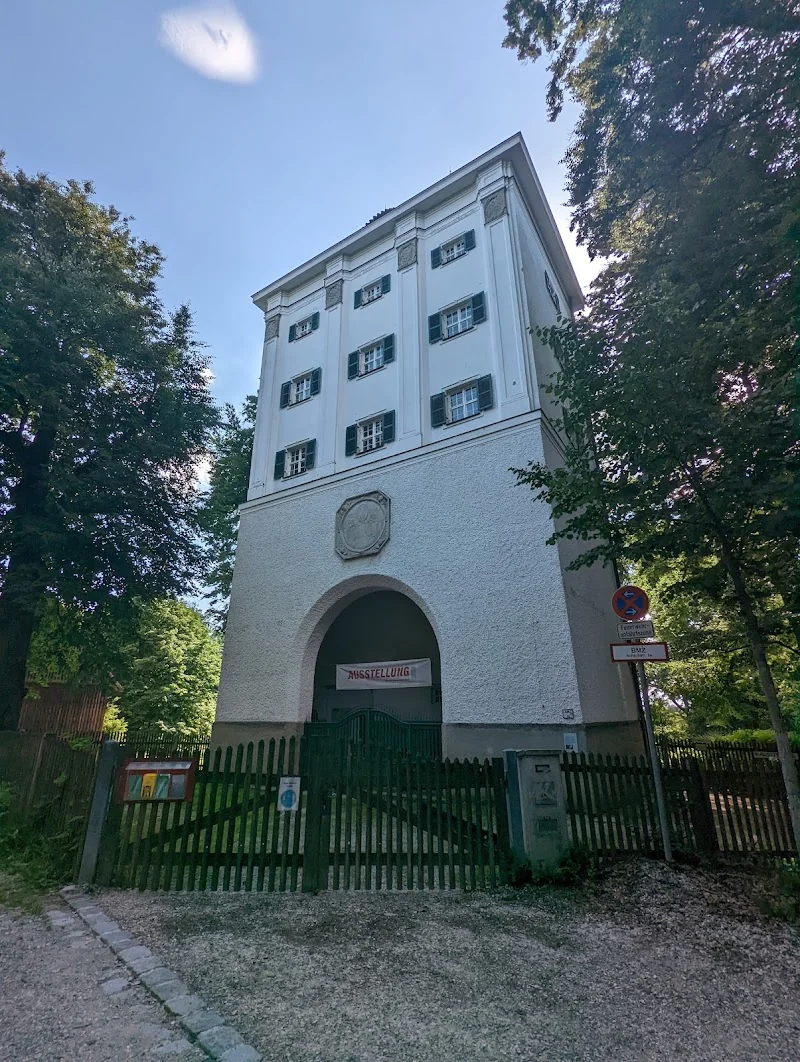
Schloßstraße 7A, Dachau
Schloßstraße 7A, 85221 Dachau, Germany
Dachau Water Tower | Exhibition & Support Association
The Dachau Water Tower is one of the most unusual cultural sites in Upper Bavaria. It rises on the Schlossberg in close proximity to Dachau Castle and impressively connects the history of technology with contemporary culture. Put into operation in 1910 for the municipal water supply, the striking building still shapes the silhouette of the old town today. Since 1998, the multi-story tower rooms have been curated with exhibitions, readings, and concerts, organized by the dedicated Dachau Water Tower Support Association. Visitors appreciate the special atmosphere of the narrow stairs, the circular rooms, and the changing light that falls through narrow openings and under the roof. The tower has no fixed opening hours, as it opens specifically for the respective exhibitions; this makes the visit planable and allows for concentrated encounters with art. Getting there is easy: Official access description via Hofgartenweg, additional navigation details often lead via Schloßstraße. Parking is available at the top of the Schlossplatz and in the parking garage on Wieningerstraße; with city bus line 718, you can reach the stops Dachau Water Tower or Dachau Castle. Thus, a technical monument becomes a vibrant cultural space that makes history tangible and showcases contemporary art from the region and beyond.
Exhibitions and Program at the Dachau Water Tower
The exhibition program at the Dachau Water Tower has been curated by the support association since 1998 and includes visual arts, photography, graphics, installations, as well as smaller concert and reading formats. Due to the special architecture of the tower, projects that respond to or engage in dialogue with the spatial situation are preferred. The rooms are distributed over several floors; the floor plans show levels from the first to the fourth floor, including the attic. This vertical sequence creates a dramatic tension during the tour: Those who climb the narrow staircase experience exhibition sequences almost like chapters that are entered and experienced one after the other. The absence of fixed opening hours is conceptually justified and practical: The tower opens at clearly defined exhibition dates with communicated visiting times. This allows for the planning and execution of setup and dismantling, art education, and events in a relaxed manner. An example of the spectrum is the collaboration with local and international partners, such as photography projects together with Dachau cultural institutions; the city published information about photography exhibitions in the water tower. Artists repeatedly present site-specific works that take up the character of the tower, such as light flows, the beam structure in the attic, or the round walkway along the outer wall. Due to the proximity to the Schlossberg and the Hofgarten, the outdoor space can also be incorporated into artistic concepts. Additionally, there are individual events such as readings and small concerts that appear particularly intimate due to the acoustic peculiarities of the tower rooms. A fixed program highlight in the city is the Long Night of Open Doors, which has been organized by the support association since the late 2000s and has grown into a popular attraction over the years. Thus, the tower makes art accessible to a broad audience in recurring formats without losing the individual character of its exhibitions.
Address, Directions, and Parking at Schlossberg
The water tower is located on the Dachau Schlossberg near the castle in the old town. For postal and on-site information, the address Hofgartenweg, 85221 Dachau, is communicated. In navigation systems, additional entries such as Schloßstraße 7A may appear; this information also reliably leads visitors to the location on the Schlossberg. The journey by public transport is straightforward: From Dachau train station, which is accessible via the S-Bahn line S 2 from Munich, city buses travel to the old town. Particularly convenient is city bus line 718, which, according to the route plan, serves stops named Dachau Water Tower and Dachau Castle. Those who wish to walk can reach the tower from the train station in a longer but atmospheric uphill walk through the old town, passing cafés, small shops, and historic houses. For drivers, it is important to note that there are no dedicated parking spaces at the tower itself. The city and the support association recommend parking at the Schlossplatz above the Schlossberg and in the parking garage on Wieningerstraße. In the old town, there are additional parking zones, some of which are time-limited and require a parking disc. Due to the location on the Schlossberg, it is advisable to plan a few minutes for the walk from the parking lot to the tower. The access route is well signposted, and the proximity to the castle facilitates orientation. Those arriving by bicycle will find options for secure parking in the vicinity; however, the steeper topography of the Schlossberg should be taken into account. For group arrivals, it is advisable to check the visitor information in advance, especially during parallel events in the old town when streets are closed or parking pressure increases. The combination of bus connections, old town parking, and clear route guidance makes it easy to integrate a visit to the tower into a walk through the Hofgarten and castle area.
Photos and Photo Motifs around the Water Tower
The water tower is a popular motif for photography, both because of its historic architecture and its location above the rooftops of the old town. The tiered levels of the tower, the narrow window openings, and the wooden roof structure offer appealing perspectives both inside and outside. As part of the cultural program, photography projects and photo exhibitions have been realized, in which local associations and partners are involved. Those visiting the tower experience changing hangings and installations in the exhibition rooms, often with targeted lighting. For personal outdoor shots, the view from the Schlossplatz towards the tower is worthwhile, especially during the golden hour when the Schlossberg captures warm light. The paths along Hofgartenweg and the areas around the Bürgerbiergarten in the old town also offer interesting views framed by trees and walls. Indoor shots should be coordinated with the exhibition conditions; typically, there are design and conservation guidelines that are communicated on-site. Since there is no elevator and the stairs can be narrow, planning is advisable for extensive photo equipment. The room layouts show that there are presentation areas on several floors; this allows for curated photo sequences that unfold floor by floor. The attic with visible beams creates graphic lines and recurring structures that inspire photographers to series. Those who want to capture the interplay of art and space pay attention to details such as the curvature of the outer wall, niches, and the fine tuning between natural light and spot lighting. Additionally, urban motifs can be captured in the surroundings: Dachau Castle, the Hofgarten, and the cobblestone streets of the old town. The city regularly publishes information about ongoing photo exhibitions in the event calendar; this provides a good starting point to combine visits and photographic interests. Thus, the water tower is not only a venue for exhibitions but also a stage for image series that bring together urban history and contemporary art.
Dachau Water Tower Support Association: History, Goals, Engagement
The Dachau Water Tower Support Association was founded in September 1998 by citizens. The goal is to make the tower culturally usable, keep it accessible to the public, and organize exhibitions, readings, and concerts. Since its founding, a curated annual program has been implemented that involves local and regional artists and promotes cooperation with municipal institutions. This civic sponsorship is a key reason for the continuity and quality of the events. Organizational information, such as program coordination, and information for exhibitors like floor plans, technical specifics, and downloads are provided by the association on its website. The floor plan documents make it clear how carefully the spaces are used: The floors are arranged differently, there is a counter area on the second floor, visible roof beams in the upper area, and marked elements such as radiators and sockets. All of this facilitates the planning of hangings or space-consuming works. The association is also networked in the local cultural scene and shapes formats such as the Long Night of Open Doors, where visitors can experience many cultural sites in a short time. Thanks to its proximity to the Schlossberg, the water tower serves as a hinge between city history and contemporary art, which attracts interest from the public and media. Participation in the association is open to interested parties; memberships and support options are communicated transparently. This demonstrates how a technical monument in municipal ownership can be permanently filled with life through civic engagement. For Dachau, the tower is not only a visual highlight but also a place where city identity, volunteer engagement, and cultural education intertwine.
Biergarten and Surroundings: Culture and Enjoyment around the Tower
Directly at the water tower, there is no dedicated beer garden, but in the old town on the Schlossberg lies the Bürgerbiergarten, a popular meeting place in the warm season. The spatial proximity of the cultural site and beer garden makes it easy to combine a visit to the exhibition with a short stop for refreshments. Discussions in city politics show that the immediate surroundings of the tower are perceived as a sensitive cultural and monument area. In the public debate, the establishment of a pétanque court in the area was even considered; ultimately, the decision was made in favor of cultural use and ensemble protection against a recreational area directly next to the tower. These decisions underline how closely city life, monument protection, and cultural work are coordinated in Dachau. Visitors benefit from this: The path from Schlossplatz to the tower leads past historic walls and green areas, and those who stop in the beer garden or in one of the cafés in the old town experience the cultural environment in a relaxed atmosphere. For groups wishing to combine an exhibition with a cozy conclusion, it is advisable to travel by bus to Schloss Dachau or Dachau Water Tower, as parking spaces at Schlossplatz are limited. In the evening, the lighting around the castle and tower contributes to the atmosphere, making even a short walk after the event a pleasant conclusion. Overall, a harmonious overall picture emerges from cultural enjoyment, urban nature, and Bavarian conviviality, enriching the stay at the water tower beyond just the exhibition visit.
History and Special Features: From 1910 to Today
The Dachau Water Tower was commissioned in 1910 and was a milestone for the young municipal water supply. For more than half a century, the building ensured sufficient water pressure in the city. In 1969, a new elevated tank in Günding took over this task, causing the tower to lose its original function. In the 1980s, there was even consideration of demolition or alternative uses. Ultimately, the city decided to preserve the tower, renovate it, and establish it as a cultural site. Since 1998, it has been used for exhibitions, readings, and concerts. The spatial peculiarities are a defining feature of the visitor experience: Access is via a narrow staircase, and there are about 100 steps to the first floor. There is no elevator, which limits accessibility. The floor plans document a clear floor division up to the attic with visible beams and variable hanging and display areas. This characteristic makes the tower attractive for curated art and photography projects that utilize the verticality and sequence of the rooms. The strong local connection is also explained by its history: As a technical monument, the tower belongs to the city of Dachau and is an identity-forming place that rounds off the Schlossberg as a cultural area. The proximity to Dachau Castle also facilitates integration into urban cultural events and tourist offerings. Practically relevant are the visitor notes: no fixed opening hours, access via Hofgartenweg, parking at Schlossplatz or in the parking garage on Wieningerstraße, as well as available old town parking zones. Toilets are located in the tower but are only accessible via stairs. Those arriving by public transport can use city bus 718 from Dachau train station, which serves the stops Dachau Water Tower and Dachau Castle. Together, a profile emerges that connects tradition and present: a building opened in 1910 that did not fall into oblivion after the end of its supply task in 1969 but has since 1998 convinced as a vibrant cultural and exhibition site.
Sources:
- Dachau Water Tower Support Association – Visitor Information
- Dachau Water Tower Support Association – Address and Directions
- Dachau Water Tower Support Association – Association Info and Goals
- Dachau City Utilities – Route Plan City Bus 718
- Süddeutsche Zeitung – Dachau Water Tower, Support Association and Events
- Wikipedia (it) – Dachau Water Tower, Year of Construction 1910, Use Since 1998
- Merkur – Bürgerbiergarten and Surroundings at Schlossberg, Decision Against Pétanque Court
- City of Dachau – Photo Exhibition at the Dachau Water Tower
Show moreShow less
Dachau Water Tower | Exhibition & Support Association
The Dachau Water Tower is one of the most unusual cultural sites in Upper Bavaria. It rises on the Schlossberg in close proximity to Dachau Castle and impressively connects the history of technology with contemporary culture. Put into operation in 1910 for the municipal water supply, the striking building still shapes the silhouette of the old town today. Since 1998, the multi-story tower rooms have been curated with exhibitions, readings, and concerts, organized by the dedicated Dachau Water Tower Support Association. Visitors appreciate the special atmosphere of the narrow stairs, the circular rooms, and the changing light that falls through narrow openings and under the roof. The tower has no fixed opening hours, as it opens specifically for the respective exhibitions; this makes the visit planable and allows for concentrated encounters with art. Getting there is easy: Official access description via Hofgartenweg, additional navigation details often lead via Schloßstraße. Parking is available at the top of the Schlossplatz and in the parking garage on Wieningerstraße; with city bus line 718, you can reach the stops Dachau Water Tower or Dachau Castle. Thus, a technical monument becomes a vibrant cultural space that makes history tangible and showcases contemporary art from the region and beyond.
Exhibitions and Program at the Dachau Water Tower
The exhibition program at the Dachau Water Tower has been curated by the support association since 1998 and includes visual arts, photography, graphics, installations, as well as smaller concert and reading formats. Due to the special architecture of the tower, projects that respond to or engage in dialogue with the spatial situation are preferred. The rooms are distributed over several floors; the floor plans show levels from the first to the fourth floor, including the attic. This vertical sequence creates a dramatic tension during the tour: Those who climb the narrow staircase experience exhibition sequences almost like chapters that are entered and experienced one after the other. The absence of fixed opening hours is conceptually justified and practical: The tower opens at clearly defined exhibition dates with communicated visiting times. This allows for the planning and execution of setup and dismantling, art education, and events in a relaxed manner. An example of the spectrum is the collaboration with local and international partners, such as photography projects together with Dachau cultural institutions; the city published information about photography exhibitions in the water tower. Artists repeatedly present site-specific works that take up the character of the tower, such as light flows, the beam structure in the attic, or the round walkway along the outer wall. Due to the proximity to the Schlossberg and the Hofgarten, the outdoor space can also be incorporated into artistic concepts. Additionally, there are individual events such as readings and small concerts that appear particularly intimate due to the acoustic peculiarities of the tower rooms. A fixed program highlight in the city is the Long Night of Open Doors, which has been organized by the support association since the late 2000s and has grown into a popular attraction over the years. Thus, the tower makes art accessible to a broad audience in recurring formats without losing the individual character of its exhibitions.
Address, Directions, and Parking at Schlossberg
The water tower is located on the Dachau Schlossberg near the castle in the old town. For postal and on-site information, the address Hofgartenweg, 85221 Dachau, is communicated. In navigation systems, additional entries such as Schloßstraße 7A may appear; this information also reliably leads visitors to the location on the Schlossberg. The journey by public transport is straightforward: From Dachau train station, which is accessible via the S-Bahn line S 2 from Munich, city buses travel to the old town. Particularly convenient is city bus line 718, which, according to the route plan, serves stops named Dachau Water Tower and Dachau Castle. Those who wish to walk can reach the tower from the train station in a longer but atmospheric uphill walk through the old town, passing cafés, small shops, and historic houses. For drivers, it is important to note that there are no dedicated parking spaces at the tower itself. The city and the support association recommend parking at the Schlossplatz above the Schlossberg and in the parking garage on Wieningerstraße. In the old town, there are additional parking zones, some of which are time-limited and require a parking disc. Due to the location on the Schlossberg, it is advisable to plan a few minutes for the walk from the parking lot to the tower. The access route is well signposted, and the proximity to the castle facilitates orientation. Those arriving by bicycle will find options for secure parking in the vicinity; however, the steeper topography of the Schlossberg should be taken into account. For group arrivals, it is advisable to check the visitor information in advance, especially during parallel events in the old town when streets are closed or parking pressure increases. The combination of bus connections, old town parking, and clear route guidance makes it easy to integrate a visit to the tower into a walk through the Hofgarten and castle area.
Photos and Photo Motifs around the Water Tower
The water tower is a popular motif for photography, both because of its historic architecture and its location above the rooftops of the old town. The tiered levels of the tower, the narrow window openings, and the wooden roof structure offer appealing perspectives both inside and outside. As part of the cultural program, photography projects and photo exhibitions have been realized, in which local associations and partners are involved. Those visiting the tower experience changing hangings and installations in the exhibition rooms, often with targeted lighting. For personal outdoor shots, the view from the Schlossplatz towards the tower is worthwhile, especially during the golden hour when the Schlossberg captures warm light. The paths along Hofgartenweg and the areas around the Bürgerbiergarten in the old town also offer interesting views framed by trees and walls. Indoor shots should be coordinated with the exhibition conditions; typically, there are design and conservation guidelines that are communicated on-site. Since there is no elevator and the stairs can be narrow, planning is advisable for extensive photo equipment. The room layouts show that there are presentation areas on several floors; this allows for curated photo sequences that unfold floor by floor. The attic with visible beams creates graphic lines and recurring structures that inspire photographers to series. Those who want to capture the interplay of art and space pay attention to details such as the curvature of the outer wall, niches, and the fine tuning between natural light and spot lighting. Additionally, urban motifs can be captured in the surroundings: Dachau Castle, the Hofgarten, and the cobblestone streets of the old town. The city regularly publishes information about ongoing photo exhibitions in the event calendar; this provides a good starting point to combine visits and photographic interests. Thus, the water tower is not only a venue for exhibitions but also a stage for image series that bring together urban history and contemporary art.
Dachau Water Tower Support Association: History, Goals, Engagement
The Dachau Water Tower Support Association was founded in September 1998 by citizens. The goal is to make the tower culturally usable, keep it accessible to the public, and organize exhibitions, readings, and concerts. Since its founding, a curated annual program has been implemented that involves local and regional artists and promotes cooperation with municipal institutions. This civic sponsorship is a key reason for the continuity and quality of the events. Organizational information, such as program coordination, and information for exhibitors like floor plans, technical specifics, and downloads are provided by the association on its website. The floor plan documents make it clear how carefully the spaces are used: The floors are arranged differently, there is a counter area on the second floor, visible roof beams in the upper area, and marked elements such as radiators and sockets. All of this facilitates the planning of hangings or space-consuming works. The association is also networked in the local cultural scene and shapes formats such as the Long Night of Open Doors, where visitors can experience many cultural sites in a short time. Thanks to its proximity to the Schlossberg, the water tower serves as a hinge between city history and contemporary art, which attracts interest from the public and media. Participation in the association is open to interested parties; memberships and support options are communicated transparently. This demonstrates how a technical monument in municipal ownership can be permanently filled with life through civic engagement. For Dachau, the tower is not only a visual highlight but also a place where city identity, volunteer engagement, and cultural education intertwine.
Biergarten and Surroundings: Culture and Enjoyment around the Tower
Directly at the water tower, there is no dedicated beer garden, but in the old town on the Schlossberg lies the Bürgerbiergarten, a popular meeting place in the warm season. The spatial proximity of the cultural site and beer garden makes it easy to combine a visit to the exhibition with a short stop for refreshments. Discussions in city politics show that the immediate surroundings of the tower are perceived as a sensitive cultural and monument area. In the public debate, the establishment of a pétanque court in the area was even considered; ultimately, the decision was made in favor of cultural use and ensemble protection against a recreational area directly next to the tower. These decisions underline how closely city life, monument protection, and cultural work are coordinated in Dachau. Visitors benefit from this: The path from Schlossplatz to the tower leads past historic walls and green areas, and those who stop in the beer garden or in one of the cafés in the old town experience the cultural environment in a relaxed atmosphere. For groups wishing to combine an exhibition with a cozy conclusion, it is advisable to travel by bus to Schloss Dachau or Dachau Water Tower, as parking spaces at Schlossplatz are limited. In the evening, the lighting around the castle and tower contributes to the atmosphere, making even a short walk after the event a pleasant conclusion. Overall, a harmonious overall picture emerges from cultural enjoyment, urban nature, and Bavarian conviviality, enriching the stay at the water tower beyond just the exhibition visit.
History and Special Features: From 1910 to Today
The Dachau Water Tower was commissioned in 1910 and was a milestone for the young municipal water supply. For more than half a century, the building ensured sufficient water pressure in the city. In 1969, a new elevated tank in Günding took over this task, causing the tower to lose its original function. In the 1980s, there was even consideration of demolition or alternative uses. Ultimately, the city decided to preserve the tower, renovate it, and establish it as a cultural site. Since 1998, it has been used for exhibitions, readings, and concerts. The spatial peculiarities are a defining feature of the visitor experience: Access is via a narrow staircase, and there are about 100 steps to the first floor. There is no elevator, which limits accessibility. The floor plans document a clear floor division up to the attic with visible beams and variable hanging and display areas. This characteristic makes the tower attractive for curated art and photography projects that utilize the verticality and sequence of the rooms. The strong local connection is also explained by its history: As a technical monument, the tower belongs to the city of Dachau and is an identity-forming place that rounds off the Schlossberg as a cultural area. The proximity to Dachau Castle also facilitates integration into urban cultural events and tourist offerings. Practically relevant are the visitor notes: no fixed opening hours, access via Hofgartenweg, parking at Schlossplatz or in the parking garage on Wieningerstraße, as well as available old town parking zones. Toilets are located in the tower but are only accessible via stairs. Those arriving by public transport can use city bus 718 from Dachau train station, which serves the stops Dachau Water Tower and Dachau Castle. Together, a profile emerges that connects tradition and present: a building opened in 1910 that did not fall into oblivion after the end of its supply task in 1969 but has since 1998 convinced as a vibrant cultural and exhibition site.
Sources:
- Dachau Water Tower Support Association – Visitor Information
- Dachau Water Tower Support Association – Address and Directions
- Dachau Water Tower Support Association – Association Info and Goals
- Dachau City Utilities – Route Plan City Bus 718
- Süddeutsche Zeitung – Dachau Water Tower, Support Association and Events
- Wikipedia (it) – Dachau Water Tower, Year of Construction 1910, Use Since 1998
- Merkur – Bürgerbiergarten and Surroundings at Schlossberg, Decision Against Pétanque Court
- City of Dachau – Photo Exhibition at the Dachau Water Tower
Dachau Water Tower | Exhibition & Support Association
The Dachau Water Tower is one of the most unusual cultural sites in Upper Bavaria. It rises on the Schlossberg in close proximity to Dachau Castle and impressively connects the history of technology with contemporary culture. Put into operation in 1910 for the municipal water supply, the striking building still shapes the silhouette of the old town today. Since 1998, the multi-story tower rooms have been curated with exhibitions, readings, and concerts, organized by the dedicated Dachau Water Tower Support Association. Visitors appreciate the special atmosphere of the narrow stairs, the circular rooms, and the changing light that falls through narrow openings and under the roof. The tower has no fixed opening hours, as it opens specifically for the respective exhibitions; this makes the visit planable and allows for concentrated encounters with art. Getting there is easy: Official access description via Hofgartenweg, additional navigation details often lead via Schloßstraße. Parking is available at the top of the Schlossplatz and in the parking garage on Wieningerstraße; with city bus line 718, you can reach the stops Dachau Water Tower or Dachau Castle. Thus, a technical monument becomes a vibrant cultural space that makes history tangible and showcases contemporary art from the region and beyond.
Exhibitions and Program at the Dachau Water Tower
The exhibition program at the Dachau Water Tower has been curated by the support association since 1998 and includes visual arts, photography, graphics, installations, as well as smaller concert and reading formats. Due to the special architecture of the tower, projects that respond to or engage in dialogue with the spatial situation are preferred. The rooms are distributed over several floors; the floor plans show levels from the first to the fourth floor, including the attic. This vertical sequence creates a dramatic tension during the tour: Those who climb the narrow staircase experience exhibition sequences almost like chapters that are entered and experienced one after the other. The absence of fixed opening hours is conceptually justified and practical: The tower opens at clearly defined exhibition dates with communicated visiting times. This allows for the planning and execution of setup and dismantling, art education, and events in a relaxed manner. An example of the spectrum is the collaboration with local and international partners, such as photography projects together with Dachau cultural institutions; the city published information about photography exhibitions in the water tower. Artists repeatedly present site-specific works that take up the character of the tower, such as light flows, the beam structure in the attic, or the round walkway along the outer wall. Due to the proximity to the Schlossberg and the Hofgarten, the outdoor space can also be incorporated into artistic concepts. Additionally, there are individual events such as readings and small concerts that appear particularly intimate due to the acoustic peculiarities of the tower rooms. A fixed program highlight in the city is the Long Night of Open Doors, which has been organized by the support association since the late 2000s and has grown into a popular attraction over the years. Thus, the tower makes art accessible to a broad audience in recurring formats without losing the individual character of its exhibitions.
Address, Directions, and Parking at Schlossberg
The water tower is located on the Dachau Schlossberg near the castle in the old town. For postal and on-site information, the address Hofgartenweg, 85221 Dachau, is communicated. In navigation systems, additional entries such as Schloßstraße 7A may appear; this information also reliably leads visitors to the location on the Schlossberg. The journey by public transport is straightforward: From Dachau train station, which is accessible via the S-Bahn line S 2 from Munich, city buses travel to the old town. Particularly convenient is city bus line 718, which, according to the route plan, serves stops named Dachau Water Tower and Dachau Castle. Those who wish to walk can reach the tower from the train station in a longer but atmospheric uphill walk through the old town, passing cafés, small shops, and historic houses. For drivers, it is important to note that there are no dedicated parking spaces at the tower itself. The city and the support association recommend parking at the Schlossplatz above the Schlossberg and in the parking garage on Wieningerstraße. In the old town, there are additional parking zones, some of which are time-limited and require a parking disc. Due to the location on the Schlossberg, it is advisable to plan a few minutes for the walk from the parking lot to the tower. The access route is well signposted, and the proximity to the castle facilitates orientation. Those arriving by bicycle will find options for secure parking in the vicinity; however, the steeper topography of the Schlossberg should be taken into account. For group arrivals, it is advisable to check the visitor information in advance, especially during parallel events in the old town when streets are closed or parking pressure increases. The combination of bus connections, old town parking, and clear route guidance makes it easy to integrate a visit to the tower into a walk through the Hofgarten and castle area.
Photos and Photo Motifs around the Water Tower
The water tower is a popular motif for photography, both because of its historic architecture and its location above the rooftops of the old town. The tiered levels of the tower, the narrow window openings, and the wooden roof structure offer appealing perspectives both inside and outside. As part of the cultural program, photography projects and photo exhibitions have been realized, in which local associations and partners are involved. Those visiting the tower experience changing hangings and installations in the exhibition rooms, often with targeted lighting. For personal outdoor shots, the view from the Schlossplatz towards the tower is worthwhile, especially during the golden hour when the Schlossberg captures warm light. The paths along Hofgartenweg and the areas around the Bürgerbiergarten in the old town also offer interesting views framed by trees and walls. Indoor shots should be coordinated with the exhibition conditions; typically, there are design and conservation guidelines that are communicated on-site. Since there is no elevator and the stairs can be narrow, planning is advisable for extensive photo equipment. The room layouts show that there are presentation areas on several floors; this allows for curated photo sequences that unfold floor by floor. The attic with visible beams creates graphic lines and recurring structures that inspire photographers to series. Those who want to capture the interplay of art and space pay attention to details such as the curvature of the outer wall, niches, and the fine tuning between natural light and spot lighting. Additionally, urban motifs can be captured in the surroundings: Dachau Castle, the Hofgarten, and the cobblestone streets of the old town. The city regularly publishes information about ongoing photo exhibitions in the event calendar; this provides a good starting point to combine visits and photographic interests. Thus, the water tower is not only a venue for exhibitions but also a stage for image series that bring together urban history and contemporary art.
Dachau Water Tower Support Association: History, Goals, Engagement
The Dachau Water Tower Support Association was founded in September 1998 by citizens. The goal is to make the tower culturally usable, keep it accessible to the public, and organize exhibitions, readings, and concerts. Since its founding, a curated annual program has been implemented that involves local and regional artists and promotes cooperation with municipal institutions. This civic sponsorship is a key reason for the continuity and quality of the events. Organizational information, such as program coordination, and information for exhibitors like floor plans, technical specifics, and downloads are provided by the association on its website. The floor plan documents make it clear how carefully the spaces are used: The floors are arranged differently, there is a counter area on the second floor, visible roof beams in the upper area, and marked elements such as radiators and sockets. All of this facilitates the planning of hangings or space-consuming works. The association is also networked in the local cultural scene and shapes formats such as the Long Night of Open Doors, where visitors can experience many cultural sites in a short time. Thanks to its proximity to the Schlossberg, the water tower serves as a hinge between city history and contemporary art, which attracts interest from the public and media. Participation in the association is open to interested parties; memberships and support options are communicated transparently. This demonstrates how a technical monument in municipal ownership can be permanently filled with life through civic engagement. For Dachau, the tower is not only a visual highlight but also a place where city identity, volunteer engagement, and cultural education intertwine.
Biergarten and Surroundings: Culture and Enjoyment around the Tower
Directly at the water tower, there is no dedicated beer garden, but in the old town on the Schlossberg lies the Bürgerbiergarten, a popular meeting place in the warm season. The spatial proximity of the cultural site and beer garden makes it easy to combine a visit to the exhibition with a short stop for refreshments. Discussions in city politics show that the immediate surroundings of the tower are perceived as a sensitive cultural and monument area. In the public debate, the establishment of a pétanque court in the area was even considered; ultimately, the decision was made in favor of cultural use and ensemble protection against a recreational area directly next to the tower. These decisions underline how closely city life, monument protection, and cultural work are coordinated in Dachau. Visitors benefit from this: The path from Schlossplatz to the tower leads past historic walls and green areas, and those who stop in the beer garden or in one of the cafés in the old town experience the cultural environment in a relaxed atmosphere. For groups wishing to combine an exhibition with a cozy conclusion, it is advisable to travel by bus to Schloss Dachau or Dachau Water Tower, as parking spaces at Schlossplatz are limited. In the evening, the lighting around the castle and tower contributes to the atmosphere, making even a short walk after the event a pleasant conclusion. Overall, a harmonious overall picture emerges from cultural enjoyment, urban nature, and Bavarian conviviality, enriching the stay at the water tower beyond just the exhibition visit.
History and Special Features: From 1910 to Today
The Dachau Water Tower was commissioned in 1910 and was a milestone for the young municipal water supply. For more than half a century, the building ensured sufficient water pressure in the city. In 1969, a new elevated tank in Günding took over this task, causing the tower to lose its original function. In the 1980s, there was even consideration of demolition or alternative uses. Ultimately, the city decided to preserve the tower, renovate it, and establish it as a cultural site. Since 1998, it has been used for exhibitions, readings, and concerts. The spatial peculiarities are a defining feature of the visitor experience: Access is via a narrow staircase, and there are about 100 steps to the first floor. There is no elevator, which limits accessibility. The floor plans document a clear floor division up to the attic with visible beams and variable hanging and display areas. This characteristic makes the tower attractive for curated art and photography projects that utilize the verticality and sequence of the rooms. The strong local connection is also explained by its history: As a technical monument, the tower belongs to the city of Dachau and is an identity-forming place that rounds off the Schlossberg as a cultural area. The proximity to Dachau Castle also facilitates integration into urban cultural events and tourist offerings. Practically relevant are the visitor notes: no fixed opening hours, access via Hofgartenweg, parking at Schlossplatz or in the parking garage on Wieningerstraße, as well as available old town parking zones. Toilets are located in the tower but are only accessible via stairs. Those arriving by public transport can use city bus 718 from Dachau train station, which serves the stops Dachau Water Tower and Dachau Castle. Together, a profile emerges that connects tradition and present: a building opened in 1910 that did not fall into oblivion after the end of its supply task in 1969 but has since 1998 convinced as a vibrant cultural and exhibition site.
Sources:
- Dachau Water Tower Support Association – Visitor Information
- Dachau Water Tower Support Association – Address and Directions
- Dachau Water Tower Support Association – Association Info and Goals
- Dachau City Utilities – Route Plan City Bus 718
- Süddeutsche Zeitung – Dachau Water Tower, Support Association and Events
- Wikipedia (it) – Dachau Water Tower, Year of Construction 1910, Use Since 1998
- Merkur – Bürgerbiergarten and Surroundings at Schlossberg, Decision Against Pétanque Court
- City of Dachau – Photo Exhibition at the Dachau Water Tower
Upcoming Events
No events found
Frequently Asked Questions
Reviews
Bernd Witta
1. June 2024
It was my first time here for an outstandingly impressive exhibition of Dachau based artist G.-R. Mey. Generally, the place breathes a very special atmosphere and is highly recommended for exhibitions.
Antonio C J
6. February 2026
This tower supplied water to the city between 1910 and 1969. It fell into disrepair and was restored in 1998. Thanks to the Dachau Water Tower Support Association, it has become a cultural meeting place where exhibitions, readings, and concerts are held. Check the opening hours because I think it was closed, at least when I visited. I was also a little disappointed because I was expecting something different. Since it's next to the palace gardens, you can pop in and see it.
Rolf Lorenz
22. July 2018
The tower has been beautifully restored, and the exhibition I saw there was really well done. I met some lovely artists there, learned a lot about bees, and created a fantastic, hands-on creative activity. Even though there's no exhibition, the whole area around Dachau Castle, including the park and the view, is worth a little trip.
Reinhard Mohr
1. June 2018
The Dachau Water Tower is always worth a visit – both inside and out. It stands in the immediate vicinity of Dachau Palace and its park, making it beautifully situated – with a playground right in front. But it also offers an impressive sight in its own right, as an architectural and cultural-historical gem. And the interior is equally worth seeing. When it's open for tours or exhibitions – the upper floors are fantastic – the climb up the narrow, steep, but interesting staircase is always worthwhile. Even the old, black, still-intact water pipes are very stylish and decorative. This time we were especially lucky: an exhibition upstairs in the water tower – and a concert downstairs right in front of it! Amazing!
Erika Hinterberger
10. July 2025
Very. You just need to be able to walk well. Lots of stairs!!