Open Mic & Poetry Slam in Dachau: Stages & Tips
Open Mic & Poetry Slam: How to Get on Stage in Dachau in 2026 (and Soon in Munich Too)
You have a text, a voice – and that mix of nerves and excitement to share it live. 2026 is a good time for it: In Dachau and nearby Munich, there are usually several formats, ranging from low-threshold open mics to classic poetry slams. This guide helps you find upcoming dates, prepare, and choose a stage that fits your level.
For whom? For beginners, writers, spoken word and rap enthusiasts from Dachau and the surrounding area – as well as visitors who want to experience live literature on their next trip.
Poetry Slam & Open Mic: What to Expect in 2026 (No Surprises)
Poetry Slam (Competition)
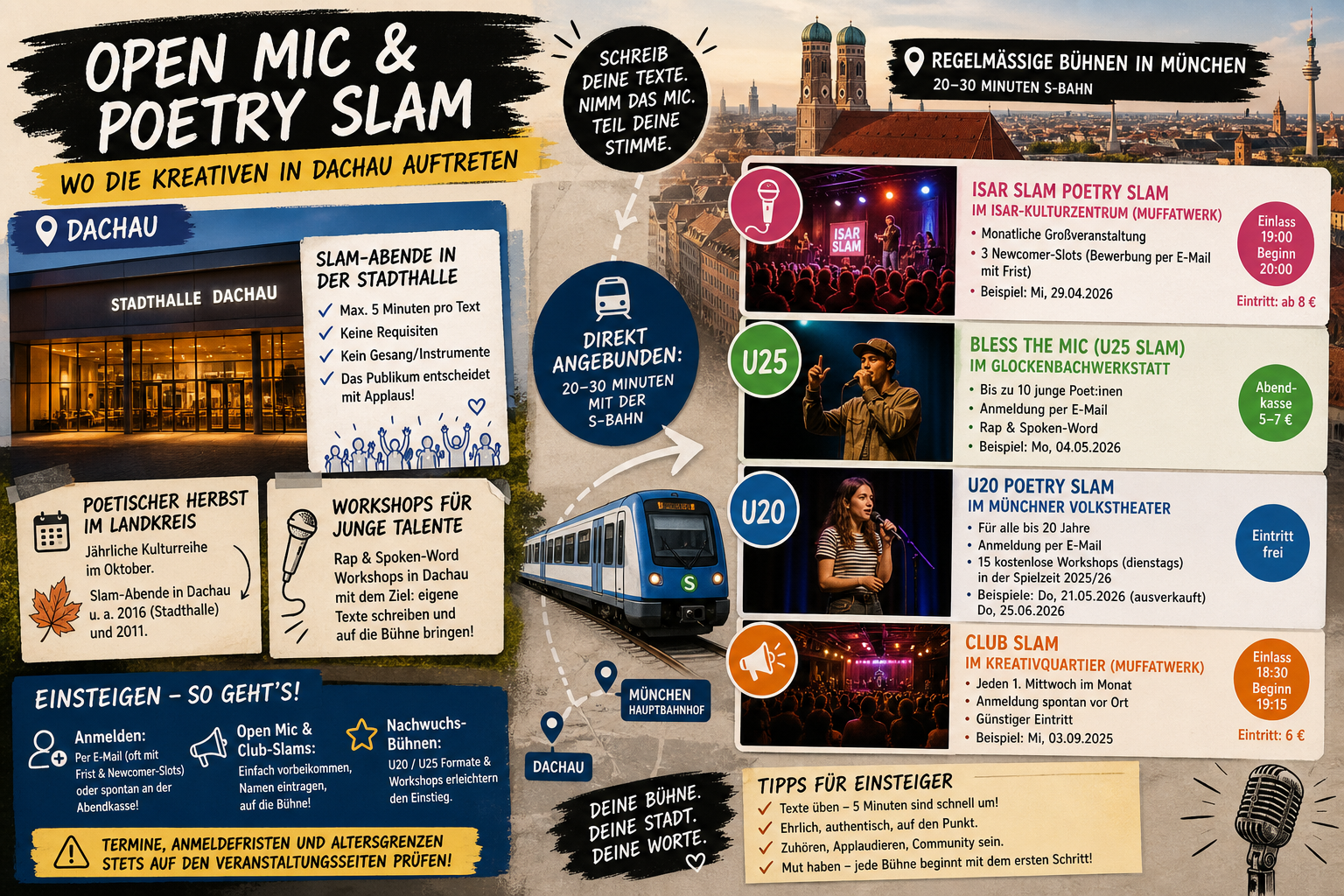
A poetry slam is a stage format where self-written texts are performed live. Common are short time limits (often around five minutes) and an audience decision (e.g., by applause or a jury from the audience). What matters is not “perfect literature,” but impact: timing, attitude, language, presence.
Open Mic (Open Stage)
An open mic is usually not competitive: You perform without points, without a final. That’s why it’s the best entry point for many in 2026. Registration often happens on site (list) or in advance (email/online form). The rules are usually stated in the respective announcement.
Typical Framework Rules You Can Expect
- Own Texts: You mostly perform self-written material; quotes are marked.
- Time Limit: Plan so that you stay safely under the specified limit.
- No “Show Props”: Many slams focus on “text & voice”; details depend on the organizer.
- Respect & House Rules: Content warnings, awareness teams, or moderation rules will be clearly communicated at many stages in 2026.
Dachau 2026: How to Reliably Find the Next Stages in the City and District
To make sure you only use information about upcoming dates, it’s best to proceed systematically in 2026. These three ways work regardless of whether a poetry slam, a literature series, or an open mic is announced:
1) Check Official Event Announcements
When Dachau or the district announces literature and cultural programs again (often seasonally, e.g., in autumn), the relevant key data are usually included: location, admission/start, ticket info, accessibility, age rules. Look for:
- Notes like “Open Stage,” “Offene Bühne,” “Slam,” “Spoken Word,” “U20/U25”
- Whether performance slots are already assigned or registrations are still open
- Contact address for performance slot applications
2) Use Youth, Culture, and Educational Venues as an Entry Point
If you’re performing for the first time in 2026, workshops or supervised formats are often the calmest entry. Such offerings often include practice phases, feedback, and a small final stage. This is especially helpful if you want to reduce stage fright and build routine.
3) Read Social Media and Newsletter Signals Correctly
Many series announce new dates at short notice. So you don’t rely on rumors, always check whether a post/story refers to an official ticket page, a website, or a contact address. If clear key data are missing, wait for the final announcement before you travel.
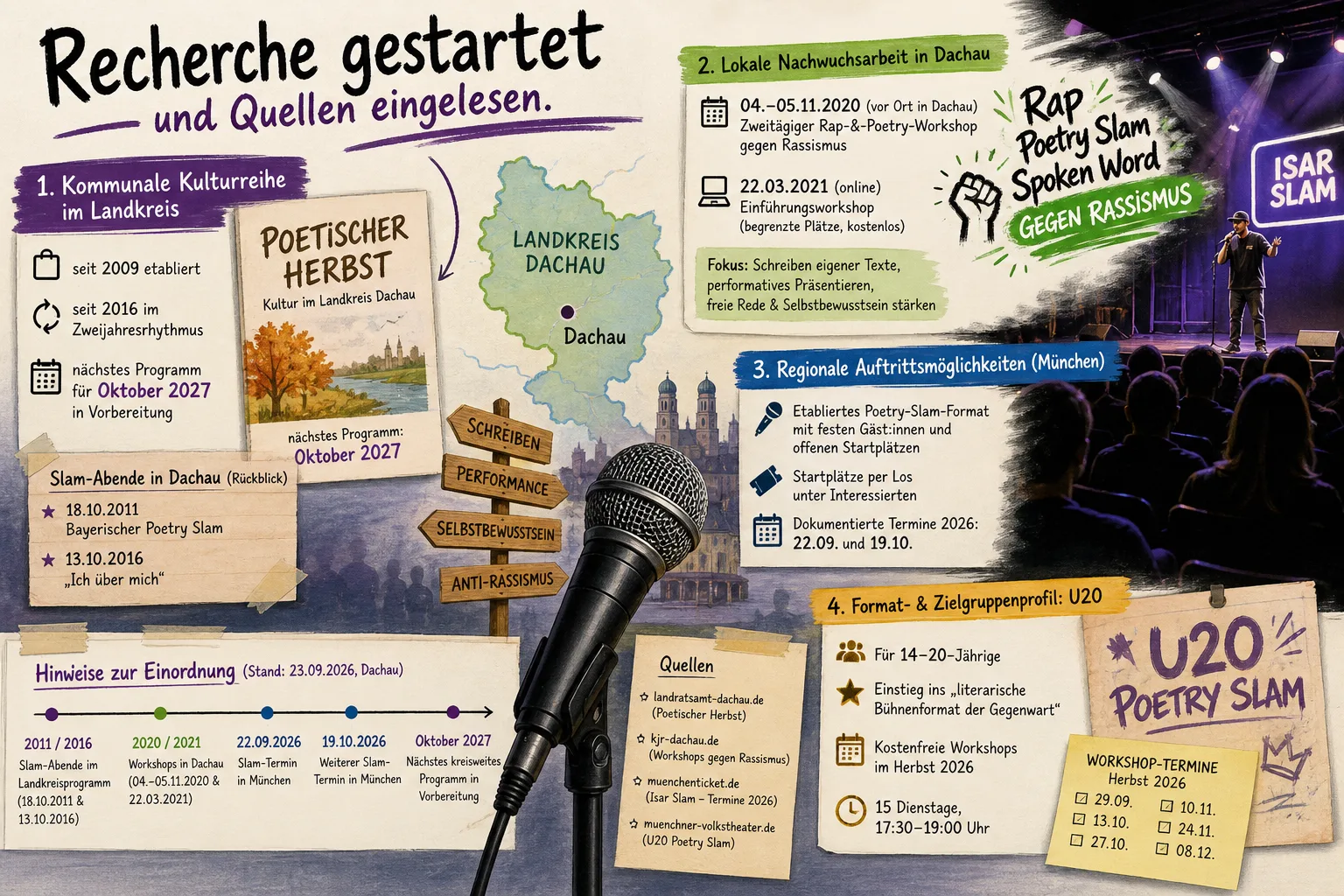
Poetic Autumn 2026: How to Use an Autumn Culture Series Strategically (If It’s Announced Again)
Autumn programs are especially practical for spoken word: They bundle several evenings into a period and make planning easy. If a literary culture series is announced again in the Dachau district for October 2026, you can pursue three goals:
- As an Audience Member: You’ll experience many styles (humorous, political, lyrical, narrative) in a short time and find your taste.
- As a Newcomer: You’ll see which formats offer performance slots (open mic vs. slam) and which registration methods are common.
- As an Author: You’ll learn moderation styles, timing, and audience dynamics – this helps you “build” your text live.
Important: Plan early for autumn programs, as ticket contingents and performance slots may be limited depending on the venue.
Your Performance 2026: Preparation in 45 Minutes (Realistic, Stage-Ready)
Step 1: Cut Your Text to 3–5 Minutes
Even if the limit differs: A text that works safely in 3–5 minutes is a good start for most open stages. Read aloud and time yourself. Cut everything that only explains instead of showing.
Step 2: Mark Three Anchor Points
- Opening Sentence: The first sentence must be immediately understandable.
- Turning Point: A clear change (thought shifts, image breaks, perspective changes).
- Final Image: An ending that “stands” – not just trails off.
Step 3: Follow Performance Rules
If the format requires “text & microphone only,” stick to it. This protects you from stress with the moderation and gives you security. If props are allowed, still decide consciously: Less is often more on stage.
Step 4: A Simple Stage Routine
- Take a deep breath, look up, stand steady.
- First line slowly – pace comes later.
- Allow a short pause after punchlines or strong lines.
Munich 2026 as a “Second Home Stage”: How to Expand Your Network Without Commuting Stress
If you live in Dachau, Munich is a natural extension: In 2026, you can find larger audiences, more series, and different style focuses there (classic slam, spoken word, rap-oriented evenings, U20/U25). To avoid planning the wrong thing, proceed as follows:
- Search for “Poetry Slam Munich” + month: Many series publish their dates monthly.
- Filter for “Performance Slot/Registration”: Some evenings assign slots in advance (email/online form), others at the entrance.
- Check Age Formats: U20/U25 often have their own rules and registration deadlines.
- Plan Return Trip & Slot Time: Calculate so that you can get home relaxed even after your performance.
This creates a sensible path in 2026: first build stage routine in the region, then test new formats in Munich – without the pressure to go “straight” to the biggest stage.
Which Format Suits You? Decision Aid for 2026
If You’re Performing for the First Time
Choose an open mic or a workshop closing night. The goal is not to “win,” but to get through cleanly: text understandable, time kept, voice steady.
If You Want Competition (and the Audience May Carry You)
Choose a poetry slam. Prepare a text that works even when you’re nervous: clear images, recognizable punchline or emotional core, definite ending.
If You’re Young (or Work with Youth Formats)
U20/U25 formats are often the best mix of stage and support in 2026. They provide structure, offer a peer audience, and make entry easier without holding you back.
Why It’s Worth It in 2026: Culture, Education, Community
Spoken word works not only as evening entertainment, but also as a training ground for language: writing, revising, performing, listening. Especially in youth and educational contexts, poetry slam formats are often used in 2026 to promote expression, self-efficacy, and perspective change. For a city like Dachau, an active stage culture can also create encounters: people don’t just come “to a show,” but to a space where many voices have room.