Career Events & Job Fairs in Dachau – Guidance & Jobs
Career Events & Job Fairs in Dachau: How to Make the Most of Upcoming Opportunities on Your Doorstep
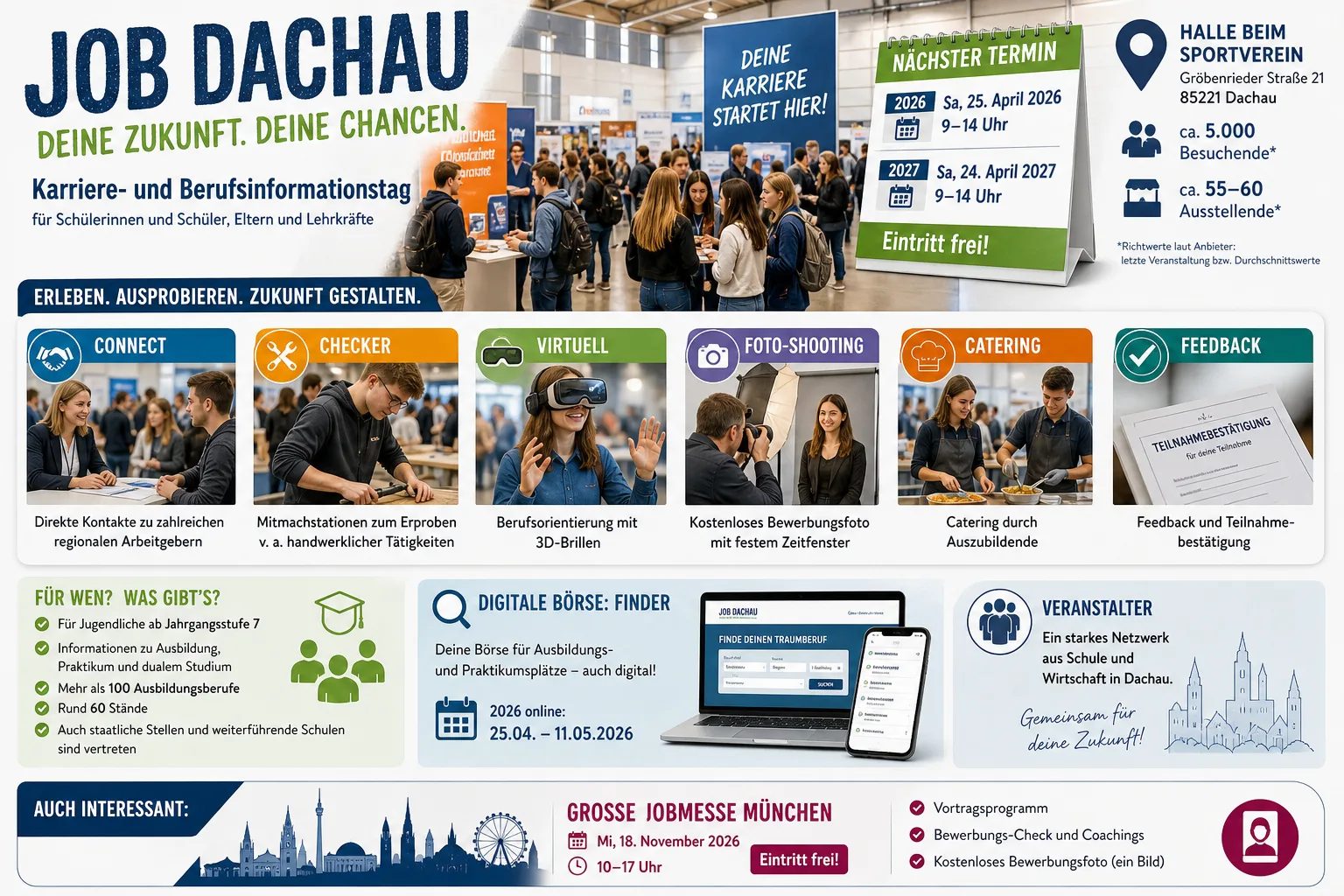
A single day at a fair can be enough to turn "no idea" into a concrete goal: apprenticeship, internship, dual study program, or a first job. In Dachau and the surrounding area, more career events are coming up in the next few months, designed exactly for this: personal conversations, practical insights, and reliable guidance.
Important: Dates, locations, and program items may change at short notice. Always check the official organizer websites before you travel.
What job fairs really offer: conversations, hands-on experience, guidance
The greatest value of a job fair comes from the combination of personal exchange and a "reality check." To make use of this, it helps to focus on the three core moments that are at the center of most upcoming Dachau career events:
1) "Connect": Conversations that give you clarity
Deliberately plan time for booth conversations. Good events bring not only recruiters, but also trainers, trainees, or professionals who can explain everyday life. Helpful questions that almost always fit:
- Which requirements are really important (grades, skills, soft skills)?
- What does a typical day in the apprenticeship/internship look like?
- How does the application process work (deadlines, documents, selection interview, trial work)?
- What development opportunities are there after completion (permanent employment, further training, specialization)?
2) "Checker": Participate instead of just listening
Many career events in the region rely on hands-on stations (e.g. crafts/technology/health/IT basics). This is especially valuable if you're still unsure, because a few minutes of practice will quickly show you if a field suits you.
3) "Guidance": Structure instead of information overload
If you feel you've "seen too much" after walking around, that's normal. Good events therefore offer short guidance modules (e.g. advice corners, mini-workshops, or pointers to reliable counseling services). Use these actively to sort your impressions: 2–3 favorites are enough as a result for the beginning.
Typical on-site modules: from VR/3D to application photos
The announcements for upcoming job fairs in Dachau often mention specific program modules. These four are especially common—and here's how to use them effectively:
Virtual insights (VR/3D tours)
Virtual tours can show you work environments you would hardly ever see "in advance" otherwise (e.g. workshop, lab, care area, office processes). Don't use this as entertainment, but as a test:
- Which activities seem appealing to you—and which don't?
- Do you prefer teamwork, clear processes, or creative/varied tasks?
- What questions arise for your booth contact (e.g. working hours, learning content, workload)?
Free application photos (with time slots)
If a photo offer is available, that's a real advantage—especially for your first round of applications. Come prepared:
- simple, clean clothing without flashy patterns
- well-groomed appearance (hair, possibly subtle styling)
- no heavy backpack on your shoulders shortly before (to avoid marks)
Important: In Germany, an application photo is usually optional. If in doubt, ask whether the company wants one, and then decide consciously.
Mini-workshops (application, resume, interview)
A 20–30 minute workshop can be more helpful than hours of online research, because you can ask questions directly. If there's an application check, bring a printed version of your resume or save it offline on your phone.
Practical catering by trainees
If trainees are offering food and drinks, it's more than just refreshments: You can easily ask how the apprenticeship and vocational school are organized, how the start went, and what they would do differently in hindsight.
Digital add-ons: job and internship boards around the fair
Many organizers link in-person fairs to digital overviews (e.g. apprenticeship and internship boards, exhibitor lists, application links). For upcoming Dachau events, this is especially useful because you can:
- filter exhibitors in advance (field of work, school qualification, start date)
- find contact details and job postings again after the fair day
- send your applications in an organized and timely manner
Set yourself a simple follow-up routine: On the evening after the fair, note for each interesting company 1) contact person, 2) desired entry (internship/apprenticeship/dual study), and 3) next step (email, online portal, phone appointment).
Checklist: How to get the most out of your fair visit
Before the fair
- Set a goal: Are you looking for an internship, an apprenticeship, a dual study program, or just guidance?
- Select 3–5 exhibitors: Less is more—you'll have better conversations this way.
- Write down questions: At least 5 questions you really want answered.
- Prepare documents: short resume (1 page), possibly your latest certificate (if available and relevant).
At the fair
- Start with a "warm-up" booth: First a practice conversation, then go to your favorites.
- Take notes immediately: After each conversation, jot down 3 keywords (friendly? does the daily routine fit? next step?).
- Plan for workshops/stations: They're often the quickest reality check.
After the fair (within 72 hours)
- Make contact: Short, polite email referring to the conversation.
- Request internship/info day: Suggest specific time frames.
- Adjust your application: Tailor your resume/cover letter to the field of work.
Guidance without pressure: If after the fair you can "only" rule out two fields of work, that's a success. Good decisions often come from deliberately leaving things out.
Also useful: job fairs in the greater Munich area
If you also include events in the greater Munich area alongside Dachau, you can sensibly broaden your spectrum: There are often additional offers for career changers, further training, application coaching, or changing industries. This complements Dachau formats especially well if you already have a direction and want to compare specifically (company sizes, job profiles, entry opportunities).
For planning, the same applies here: Check the target group of the fair in advance (students, university students, professionals, people returning to work), so you have the right conversations on site.