Discover Spiritual Places & Meditation in Dachau
Spiritual Places & Meditation in Dachau: Outlook on Upcoming Offerings and Mindful Practice
Anyone who will be living in or visiting Dachau in the coming months and years can consciously integrate meditation, contemplative music, and quiet retreats into their daily life. This guide looks ahead: at formats that typically recur (courses, open groups, concerts with elements of silence), at criteria for reputable providers, and at concrete routines that can be easily implemented in Dachau in the future.
Why a Meditative Perspective on Dachau Is Especially Worthwhile Right Now
In the coming period, meditation will become less of an “extra” and more of an everyday skill for many people: for stress regulation, better self-awareness, and respectful interaction with others. Dachau offers good conditions for this: short distances, quiet indoor spaces, green areas for walking meditation, and a cultural environment where sound and concert formats can repeatedly create space for silence.
Important: Meditation is not a competitive sport. Those who start in the future usually benefit most from small, regular sessions and a safe framework (clear guidance, breaks, voluntariness).
Which Meditation and Spirituality Formats Will Work Well in Dachau in the Future
1) Seated Meditation (Mindfulness, Zen-Inspired Practice)
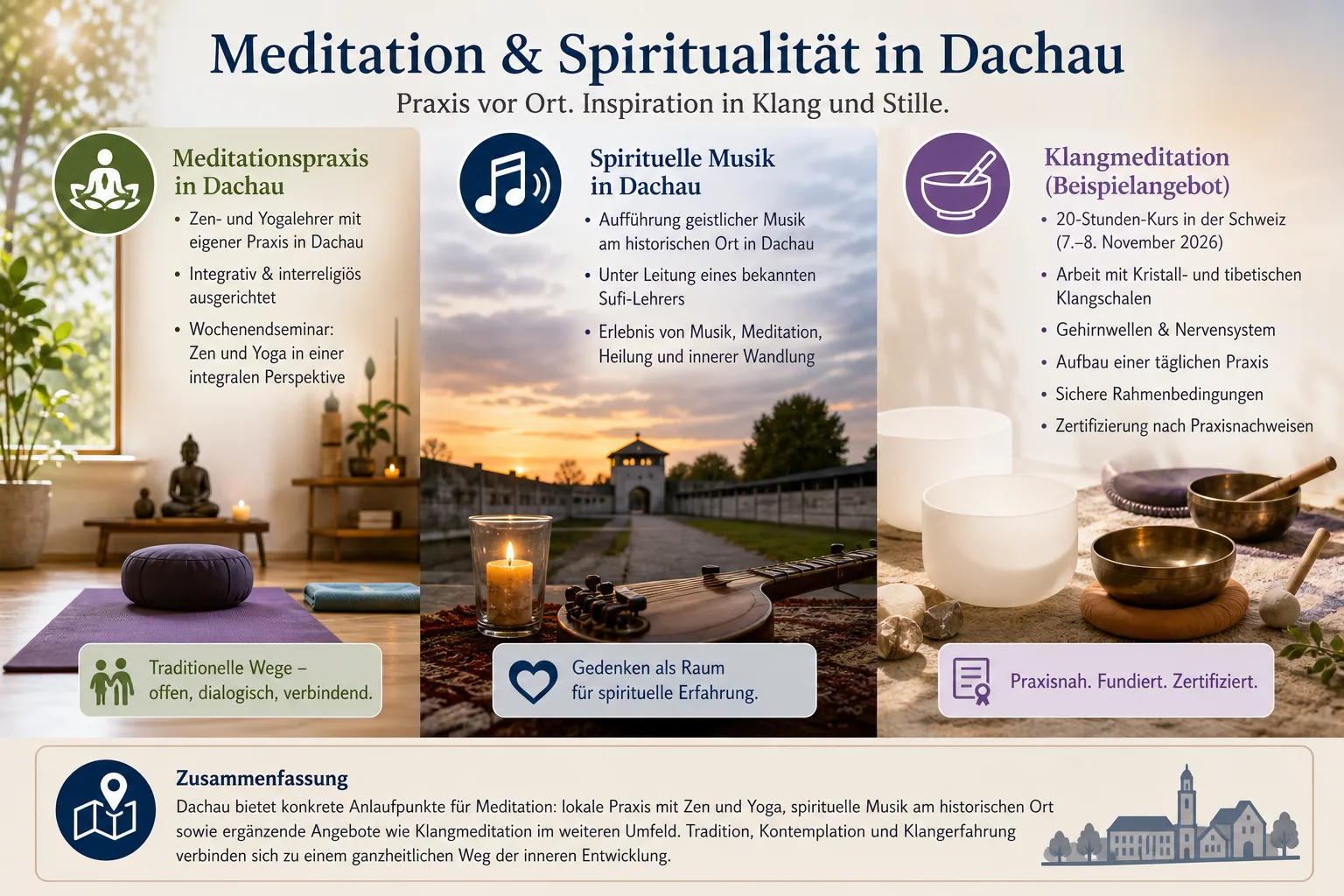
In Dachau, formats that work with silent seated meditation will continue to be suitable: adopting a posture, perceiving the breath, letting thoughts come and go. Such offerings are often open to all denominations and can be framed both secularly and spiritually.
- Typical duration: 20–45 minutes per session (often with a short introduction and closing round).
- For beginners: especially suitable if the guidance provides concrete tips on posture, dealing with restlessness, and breaks.
- For advanced practitioners: often helpful in combination with retreat days or longer practice blocks.
2) Yoga with a Focus on Mindfulness
Yoga offerings with a calm pace, conscious breathing, and clear safety communication can be used very well as “moving meditation” in the coming months. It is crucial that the practice respects physical limits and offers variations.
- Good signs: Notes on contraindications, option to skip exercises, encouraging rather than pressuring language.
- Practical benefits: Body awareness, tension relief, better self-regulation in everyday life.
3) Contemplative Music: Concerts with Elements of Silence
For the future, formats in Dachau are particularly valuable where music not only entertains but promotes conscious listening: short periods of silence between pieces, a brief introduction to mindful listening, or a calm conclusion. Churches and acoustically suitable spaces in the city can serve as appropriate “sound spaces,” provided the events are respectful, inclusive, and clearly announced.
If you attend a concert with contemplative elements in the future, this mini-routine can help:
- Before it begins: three calm breaths, relax your shoulders.
- During the music: repeatedly bring your attention back to timbre and resonance.
- Afterwards: 60 seconds of silence before speaking or reaching for your phone.
4) Walking Meditation in Urban and Green Spaces
Walking meditation is particularly suitable for people who do not like to sit for long periods. In the coming weeks, you can choose a fixed route and establish it as a regular practice: walk slowly, count steps, or link breath and steps (e.g., inhale for four steps, exhale for four steps).
How to Find Upcoming Offerings in Dachau (Without Detours)
To reliably find suitable groups, courses, or concerts in the future, a systematic approach is worthwhile:
- Municipal and cultural calendars: Check programs from cultural venues, church music, adult education center-like offerings, or local event overviews.
- Combine search terms: “Meditation Dachau,” “Mindfulness Dachau,” “Yoga calm Dachau,” “Sound meditation Dachau,” “Contemplative concert Dachau.”
- Seriousness over speed: Prefer an offering that provides clear information about the process, costs, target group, and leadership.
- Plan a trial phase: Test a format for the next 4 weeks and then decide if it is sustainable for you.
Quality and Safety Criteria for Upcoming Courses
Meditation and sound work can be very beneficial but do not have the same effect on everyone. For future offerings in Dachau, these criteria are particularly important:
- Transparent leadership: Traceable training, clear role (teacher, not “healer”), understandable limits of the method.
- Voluntariness and breaks: Ability to pause at any time, alternative postures, no group dynamics that push toward overwhelm.
- Trauma sensitivity: Calm language, no surprise intensive exercises, information on how to stabilize in case of overarousal (e.g., dizziness, panic).
- Realistic promises: No guarantees of healing; instead, concrete goals such as building practice, self-awareness, stress competence.
- Data protection and respect: Mindful handling of personal experiences in group settings.
Health note: If you suffer from severe anxiety, depression, trauma consequences, or other psychological burdens in the future, meditation can be supportive but should ideally be coordinated with professional guidance (medical/psychotherapeutic).
A Practical 30-Day Plan (Start Anytime)
If you want to build a stable routine in the next 30 days, you can use this plan. It is deliberately low-threshold and fits into a busy everyday life.
Days 1–7: Arriving
- Daily 8 minutes of seated meditation (feel the breath, notice thoughts kindly).
- Twice a week 15 minutes of gentle stretching or yoga (without performance goals).
- A walk as walking meditation (10–20 minutes).
Days 8–21: Stabilizing
- Daily 10–12 minutes of meditation.
- Once a week participation in a guided group or course format (meditation or yoga).
- “Islands of silence”: 60 seconds of silence before the first appointment of the day and before going to bed.
Days 22–30: Deepening
- Daily 15 minutes of meditation (or 2 × 8 minutes if that is easier).
- Plan a contemplative cultural experience (e.g., quiet concert format or musical devotion), with a conscious ending in silence.
- Reflection: Which exercise makes you clearer, which makes you more restless? Adjust routine accordingly.
Sound Meditation & Singing Bowls: What Makes Sense in the Future
Sound meditation (e.g., with singing bowls) can be a complementary practice in the future, especially for people who find it easier to relax through listening. For the next period, two simple basic rules apply:
- Dosage: better to start short and gentle (e.g., 10–20 minutes) than very intense right away.
- Framework: clear introduction, possibility to distance oneself (loud/quiet), calm ending without haste.
If sound offerings in the future are combined with information on stress physiology, attention, and recovery, this is a good sign of a responsible, informed approach.