Cultural Education and Societal Discourse in Dachau
Cultural Education & Societal Discourse in Dachau: Formats that Strengthen Participation in 2026/2027
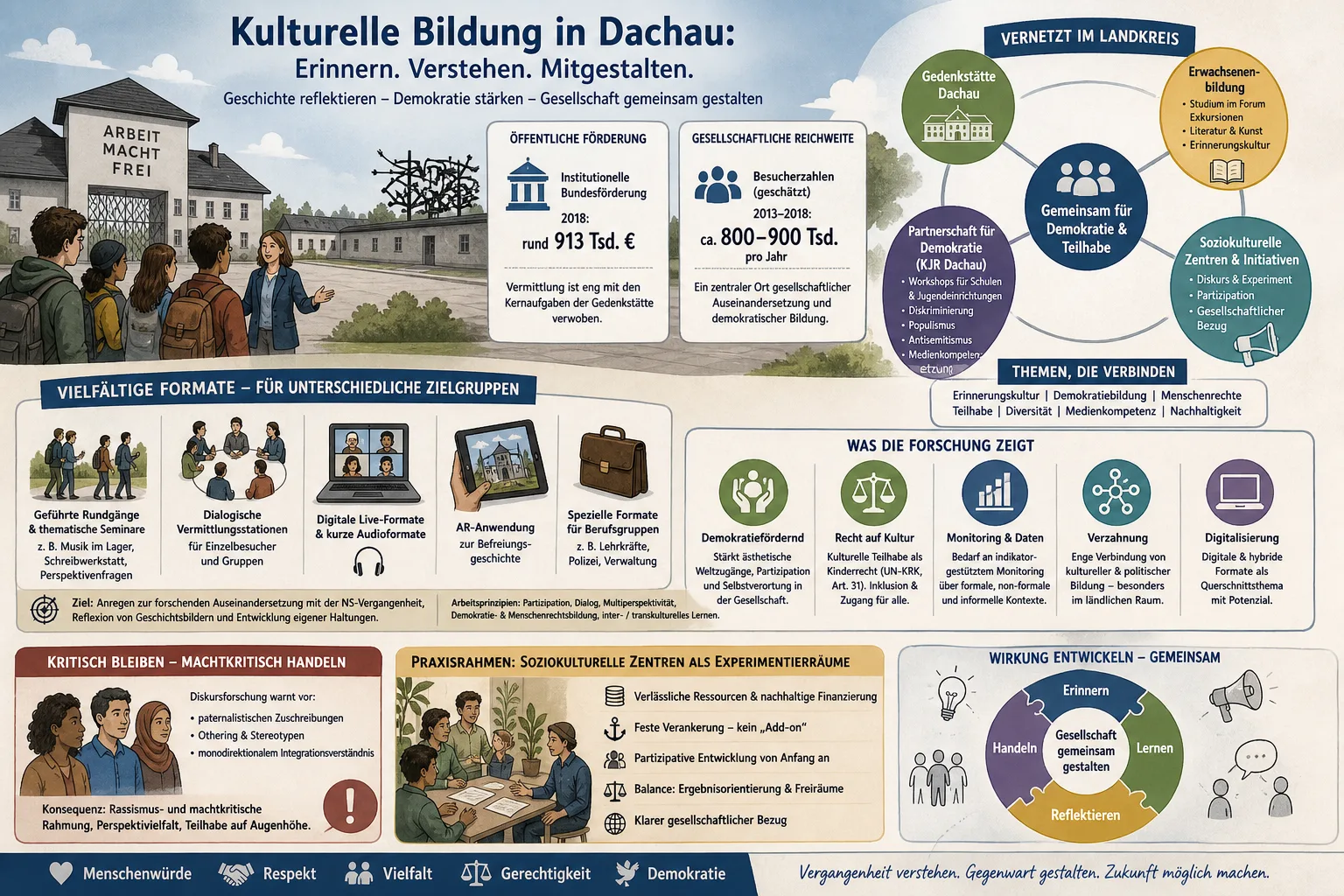
In Dachau, educational and cultural formats are being planned and implemented in the coming months and beyond 2027, which connect remembrance culture with questions of democratic participation. The focus is on offerings for school classes, young people, multipliers, and interested adults – on site and digitally.
What Will Be Central in 2026/2027
For the period from autumn 2026 onwards, formats will be particularly relevant in Dachau that not only enable societal dialogue but also accompany it in a structured way. In order for cultural education to function as a space for learning and discourse, programs will typically pursue three goals:
- Democracy and human rights education as a common thread in artistic, historical, and media education offerings.
- Participation through dialogical formats in which participants help set topics, prioritize questions, and present results.
- Media literacy to better classify disinformation, conspiracy narratives, and polarization in digital everyday life.
It will be crucial that offerings do not remain isolated events, but are designed as series, project weeks, or recurring workshops, so that sustainable learning processes can emerge.
Educational Offerings at the Memorial Site: Planned Focuses for the Next Program Round
For upcoming program rounds at the Dachau Memorial Site, formats will likely be in demand that both take the sensitive location into account and enable a transfer to contemporary issues. Proven didactic principles will be particularly suitable for 2026/2027:
- Participatory mediation: Participants are actively involved in tasks, guiding questions, and evaluations.
- Multiperspectivity: Different sources and voices are juxtaposed to avoid premature clarity.
- Transfer to democratic practice: Results are translated into options for action (e.g., civil courage, culture of debate, municipal participation).
- Protection and sensitivity: Clear conversation rules, trigger sensitivity, and voluntary reflection opportunities will be an integral part of implementation.
Digital Mediation (incl. AR) as a Bridge to Learning Realities 2026/2027
For the next phase of cultural education, digital components will play a greater role because they support preparation, follow-up, and more accessible participation. Especially for school classes and youth groups, formats will be effective that:
- work in short, mobile learning units (audio, interactive stations, impulse questions),
- promote reflection instead of mere "effects" (e.g., image criticism, source criticism, change of perspective),
- can also be planned hybrid (parts on site, parts in the classroom or youth center).
AR elements will in future be particularly useful when they are clearly framed: What is shown, what is deliberately not shown, and what questions should arise from this for the present and democratic action?
Local Educational Landscape in the District: Formats that Will Expand Discourse Spaces in the Future
Parallel to offerings at the memorial site, in the Dachau district in the coming months, especially those types of events will be effective that combine cultural practice with societal exchange. These will typically include:
Adult Education: Readings, Lectures, and Discussion Series with Discourse Character
For 2026/2027, series formats in adult education will be particularly suitable for making complex topics accessible. Effective are constellations in which a short professional impulse is combined with a moderated discussion. In Dachau, the following topics will be particularly suitable:
- Democratic culture of debate and local participation
- Remembrance culture in everyday life (language, symbols, memorial days, public spaces)
- Digital public sphere: platform logics, radicalization spirals, counter-strategies
- Art and literature as forms of societal self-understanding
Youth Formats: Workshops on Media, Discrimination, and Participation
For offerings for young people, in 2026/2027, workshops will be particularly successful that are action-oriented and take the living environment of the participants seriously. For Dachau, the following components will likely be in the foreground:
- Dealing with disinformation: Recognizing, checking, and classifying content (including image and video verification using age-appropriate methods).
- Conspiracy narratives: Mechanisms, emotions, points of connection – and how to respectfully contradict them.
- Discrimination & antisemitism: Terms, everyday examples, perspectives of those affected, options for action.
- Municipal participation: Low-threshold ways for young people to formulate concerns, build alliances, and understand processes.
These formats will be particularly effective when they not only convey "knowledge" but also lead to concrete results (e.g., mini-campaigns, audio statements, exhibitions, poetry or debate formats with subsequent audience discussion).
Participation, Children's Rights, and Democratic Self-Education: Guidelines for Future Programs
In the planning of cultural education, in 2026/2027, more attention will be paid to ensuring that participation is not understood as "target group reached" but as co-creation. Future programs will be considered successful in particular if they:
- open up planning spaces for young people (choice of topics, formats, forms of presentation),
- reduce barriers (language, costs, accessibility, time slots, support),
- enable respectful debates (moderation, clear rules, protection concepts),
- strive for long-term impact (repetition, follow-up projects, partnerships between providers).
As a normative framework for many offerings, the understanding will apply that children and young people have a right to cultural participation and opportunities for expression, and that this participation is linked to democratic self-education.
Anti-Racist Perspectives: Quality Features that Should Become Standard in 2026/2027
In order for cultural education to remain credible and inclusive in the coming period, anti-racist quality features will need to be more strongly considered in conception and implementation. For Dachau, particularly practice-oriented criteria will be decisive:
- Diversity of perspectives: Voices of those affected are not only "invited" but are included in roles with decision-making power.
- Language and images: Materials are checked to ensure they do not cement stereotypical roles or problematize groups one-sidedly.
- Team and partner structure: Cooperations are designed so that local expertise (associations, initiatives, communities) means not just "supplying" but co-authorship.
- Feedback culture: Participant feedback is systematically collected and visibly implemented for the next round.
These points will also be important in the future because educational work in the field of democracy/human rights loses credibility particularly quickly if power asymmetries remain untouched.
How to Find and Select Suitable Offerings in 2026/2027
Anyone in Dachau who wants to participate specifically in cultural education and discourse formats in the near future will have a much better experience with a clear selection strategy. The following steps will prove effective in practice:
- Clarify the goal: Is it about building knowledge, dialogue, project work, or concrete participation?
- Check the format: Is there moderation, conversation rules, reflection phases, and transparent learning objectives?
- Fit for the group: Realistically consider age, language needs, prior experience, and resilience.
- Ensure follow-up: Agree in advance how results will be documented and continued (e.g., school project, youth committee, exhibition).
Especially with sensitive topics, good preparation and follow-up will determine whether an event remains a one-off impulse or leads to sustainable orientation and ability to act.
Sources & Further Information
- Dachau Concentration Camp Memorial Site (official website) — Program and educational information (accessed 2026-09-09)
- UNICEF: Convention on the Rights of the Child — Framework for participation and cultural inclusion (accessed 2026-09-09)
- Federal Agency for Civic Education (bpb) — Dossiers and materials on democracy, media literacy, extremism prevention (accessed 2026-09-09)
- UNESCO Digital Library — Basics and reports on media and information literacy (accessed 2026-09-09)